Класс: 6
Цели урока: (The aims of the lesson).
Обучающая: обобщение ЗУН по теме “Числительные”. (Числительные количественные, порядковые, чтение дат).
Развивающая: развивать у уч-ся умение делать выводы, находить соответствия.
Воспитательная: воспитание чувства патриотизма.
Межпредметные связи: математика, история.
Оборудование: доска, учебник, магнитофон.
Оргмомент и фонетическая зарядка: (Warming up)
Орг.момент. (The Start of the Lesson)
- Good afternoon, children! Sit down, please! How are you today? Are you fine? I am fine too. Tell me, please, who is absent today? All right. We shall speak about numerals today. This lesson will help you to use the numbers better. Let ‘s warm up! Speak after me:
- Sick-thick
- free-three
- Sink-think
- fin-thin
- Mouse-mouth
- roof- Ruth
- Tense-tenth
Речевая зарядка: (Speakig). Tell me, please, what’s the date today? What day of the week is it today? What is the temperature today? What do you think?
Could you tell me the time, please! What’ s the time?
10.00a.m.
7.05a.m.8.15a.m.
10.25a.m.
12.30p.m.
3.40p.m.
5.45p.m.
8.55p.m
Тренировка в употреблении числительных. (Training)
- - Say what number is between:
- 10 and 12; 7 and 9; 1 and 3; 6 and 8; 2 and 4;
- 9 and 11; 3 and 5; 8 and 10; 4 and 6; 5 and 7
- For example: between 10 and 12 is 11.
- - Say what number comes after:
- - Say what number comes before:
- 3,7,10,11,4,9,2,6,5,8,12.
- 2, 11,9,1,6,10,3,7,5,4,8.
- Учитель называет числа или показывает карточку.
- Ответы учащихся:
- - Before 3 comes 2, и т. д.
- - After 2 comes 3, и т. д.
Совершенствование лексических навыков говорения: (Vocabulary).
Послушайте, я расскажу вам интересную сказку. На одной поляне растет волшебный цветок, у которого лепестки - числительные. Один раз в день эти лепестки начинают считать. При этом они называют свои порядковые номера: первый, восьмой, двенадцатый и т. д. Но происходит это только в том случае, если рядом с цветком появляется "the", а на цветок садится пчелка с именем "ТН".
Звучит это так:
- the fourth the seventh the tenth
- Listen! I’ll tell you a very interesting fairy-tale: There are a lot of beautiful flowers in the field. Their petals are numerals. One day these petals begin to count. They call their
- ordinal numerals: the first, the eighth, the 12 th and so on. But it happens only when , when “THE” appears near the flower, and a bee with the ending “TH” sits on the flower. It sounds so: the fourth the seventh the tenth
- the fifth the eight the eleventh
- the sixth the ninth the twelfth
But there are 3 petals, which sound differently:
Учащиеся повторяют числительные за учителем. (Repeat after me!)
Но есть три лепестка, которые опадают, когда прилетает пчелка. Они звучат по-другому: But there are 3 petals, which sound differently:
- the first
- the second
- the third.
- Дети снова повторяют.
Закрепление нового материала. (Production).
I.LISTEN TO THE TAPE AND WRITE THE DATES ON THE BLACKBOARD: (Ex.3 P.190)
- Please,tell me, when these people were born. Check .
- F.E. Mark (1835) Mark was born in 1835.
- Liz and Alice (1987)
- Liz and Alice were born in 1987.
- Ken and Harry (1883)
- Bill (1949)
- Jane (2001)
- Polly and Dan (1900)
- Roy and Jon (1716)
- Mrs Brown (1959)
- David and his cousin (1999)
- Mr Turner (1803)
- Ron and Richard (1613)
II .Listen to the tape and write the dates:
III.Игра с мячом.
Учитель кидает мяч, называя при этом количественное числительное. Ученик, возвращая мяч, называет порядковое. При этом происходит закрепление нового (порядковые числительные) и повторение старого (количественные числительные) материала.
Match: (P.183 Ex.7)
Do sums: (P.190 Ex.2)
Заключительный этап урока: (Finish).
- Our lesson is over.
- Your marks for the lesson are:
- Your home task is: P.193 Ex.9
1. В простых дробях
числитель выражается количественным числительным, а знаменатель – порядковым числительным:
1/3 – a (one) third
1/5 – a (one) fifth
1/8 – an (one) eighth
Однако читается:
1/ 2 – a (one) half (а не: one second)
1/4 – a (one) quarter (реже: a fourth)
Когда числитель больше единицы, знаменатель принимает окончание -s:
2/3 – two thirds
3/5 – three fifths
5/6 – five sixths
2. Существительное, следующее за дробью, стоит в единственном числе:
2/3 ton (читается: two thirds of a ton)
3/4 kilometre (читается: three quarters of a kilometre)
1/2 ton (читается: half a ton)
При этом следует обратить внимание на отсутствие артикля перед half и на отсутствие предлога of перед существительным.
3. Существительное, к которому относится смешанное число
, употребляется во множественном числе:
2 1/2 tons (читается: two and a half tons или two tons and a half)
4 1/3 tons (читается: four and a third tons или four tons and a third)
При чтении смешанного числа, целое число которого равно единице, существительное употребляется во множественном числе, когда оно читается после смешанного числа. Когда же существительное читается между единицей и дробью, оно употребляется в единственном числе:
1 1/2 hours (читается: one and a half hours или one (an) hour and a half)
1 1/3 pounds (читается: one and a third pounds или one (a) pound and a third)
4. В десятичных дробях
целое число отделяется от дроби точкой
(в русском – запятой). При чтении десятичных дробей каждая цифра читается отдельно. Точка, отделяющая целое число от дроби, читается point
. Нуль читается nought
. Если целое число равно нулю, то оно часто не читается:
0.25 – nought point two five или point two five
14.105 – one four (или fourteen) point one nought five
Существительное, следующее за десятичной дробью, стоит в единственном числе, когда целое число равно нулю:
0.25 ton (читается: nought point two five of a ton)
В других случаях существительное стоит во множественном числе:
1.25 tons (читается: one point two five tons)
23.76 tons (читается: two three point seven six tons или twenty-three point seven six tons)
5. Проценты
обозначаются следующим образом:
2% или 2 per cent. или 2 р. с. (читается: two per cent)
Per cent (сокращенно р. с.), как и русское слово процент , происходит от латинского pro centum за сто . В русском языке эти два слова слились в одно, которое стало существительным и употребляется как в единственном, так и во множественном числе. В английском языке cent не принимает окончания -s.
Дробные доли
одного процента обозначаются следующим образом:
3/8% или 3/8 per cent или 3/8 p.c. (читается: three eighths per cent, или three eighths of one per cent.)
1/2% или 1/2 per cent или 1/2 p.c. (читается: а half per cent, или a half of one per cent.)
0.2% или 0.2 per cent или 0.2 p.c. (читается: nought point two per cent, или nought point two of one per cent).
We use fractions to indicate partial amounts. They are not just used in mathmatics but also in recipes (½ litre water). Decimals are separated by a decimal point.
Construction
>We use both cardinal and ordinal numbers to create fractions. The numerator (the numeral above the line) is always a cardinal number. The denominator (the numeral below the line) is always an ordinal number.
| 1/3 | one third | 1/10 | one tenth |
| 1/5 | one fifth | 1/20 | one twentieth |
| 1/6 | one sixth | 1/100 | one hundredth |
| 1/8 | one eighth | 1/1000 | one thousandth |
Exceptions:
| 1/2 | one half |
| 1/4 | one quarter |
Numerators Greater Than One
>When a numerater is greater than one, we use the denominator in plural (we add an s ).
| 2/3 | two thirds | 2/7 | two sevenths |
| 3/4 | three quarters | 4/8 | four eighths |
| 4/5 | four fifths | 5/10 | five tenths |
| 3/6 | three sixths | 6/12 | six twelfths |
Decimal Numbers
>Decimal numbers are written with a decimal point. The digits after the decimal point are said separately.
Example: 0.135 - nought point one three five (US: zero point one three five) 3.14159 - three point one four one five nine
Singular and Plural with Fractions and Decimals
>If we want to say exactly what the fraction or decimal refers to and the value is less than one, we use the contruction of a + singuar noun. (except for 1/2, see last example)
Example: 3/4 T → three quarters of a ton 2/3 km → two thirds of a kilometre 0.743 cm → nought point seven four three of a centimetre 1/2 l → half a litre (not : one half of a litre)
If the value of the fraction or decimal is greater than one, the numeral is followed directly by a plural noun .
Example: one and a half hours three and a quarter kilos 2.5 millimetres
ПОРЯДКОВЫЕ ЧИСЛИТЕЛЬНЫЕ (ORDINAL NUMERALS)
1. Порядковые числительные образуются путем прибавления суффикса -th к соответствующим количественным числительным:
four-(the) fourth (четвертый)
seven-(the) seventh (седьмой)
eighteen-(the) eighteenth (восемнадцатый)
Исключение составляют числительные one , two , three :
one-(the) first (первый)
two-(the) second ["sekond] (второй)
three-(the) third (третий)
При образовании порядковых числительных от числительных five , eight , nine , twelve перед суффиксом -th изменяется написание основы:
five-(the) fifth (пятый)
eight-(the) eighth (восьмой)
nine-(the) ninth (девятый)
twelve-(the) twelfth (двенадцатый)
При образовании порядковых числительных от количественных числительных, оканчивающихся на -ty , конечное -у меняется на -ie :
twenty-(the) twentieth (двадцатый)
forty-(the) fortieth (сороковой)
При образовании составных порядковых числительных только последний разряд приобретает форму порядкового числительного:
(the) forty-eighth (the) fifty-third
(сорок восьмой пятьдесят третий)
2. Существительные, определяемые порядковыми числительными, употребляются с определенным артиклем:
The first mention of Moscow was in 1147
(Первое упоминание о Москве относится к 1147 году)
При обозначении номеров комнат, домов, трамваев, автобусов, троллейбусов, глав, параграфов, размеров одежды и обуви вместо порядковых числительных могут употребляться количественные числительные, при этом артикль the опускается, а числительное ставится после существительного, к которому оно относится:
the sixth room - room six (шестая комната - комната шесть)
the eighteenth page - page eighteen (восемнадцатая страница - страница восемнадцать)
http://www.homeenglish.ru/Grammarnumeralor.htm
ДРОБНЫЕ ЧИСЛИТЕЛЬНЫЕ ( FRACTIONAL NUMERALS )
1. В простых дробях (Common Fractions ) числитель выражается количественным числительным, а знаменатель порядковым:
1/7- one seventh (одна седьмая)
При чтении простых дробей, если числитель их больше единицы, к знаменателю прибавляется окончание множественного числа - s :
2/4 - two fourths -(две четвертых)
2/3 - two thirds -(две третьих)
3 1/5 - three and one fifth -(три целых и одна пятая)
1/2 - one second, a second, one half, a half -(одна вторая, половина)
1/4 -one fourth, a fourth, one quarter, a quarter -(одна четвертая, четверть)
2. В десятичных дробях (Decimal Fractions ) целое число отделяется точкой, и каждая цифра читается отдельно. Нуль читается nought (в США - zero ["zierou]) .
4.25 four point twenty-five; four point two five
0.43 nought point forty-three; nought point four three
3. Существительные, следующие за дробью, имеют форму единственного числа, и перед ними при чтении ставится предлог - of :
2/3 metre- two thirds of a metre
(две третьих метра)
0.05 ton - nought point nought five of a ton
(ноль целых пять сотых тонны)
Существительные, следующие за смешанным числом, имеют форму множественного числа и читаются без предлога of :
35 1 /9 tons -thirty-five and one ninth tons
14.65 metres -one four ( или fourteen) point six five ( или sixty-five) metres
4. В обозначениях номеров телефонов каждая цифра читается отдельно, нуль здесь читается [ о u ]:
All our lives we are surrounded by numbers. We count money we earn and spend, weight of our bags, years or months spent somewhere or with someone, hours and minutes of waiting, meters and kilometers of distance between places, etc. For all these measurements we need to use in our speech numerals. In this article we are going to discuss precisely them.
A numeral is a figure, a letter, a word (or their combinations) representing a number. They may be divided into two major types: cardinal and ordinal numerals. Cardinal numerals indicate number, quantity or amount and are used in counting. Ordinal numerals indicate order, that is, the order of things in a series. Numerals can be written in figures or words (2 or two; 25 or twenty-five; 17th or seventeenth). But in this article we’re going to discuss not only ordinal and cardinal numerals, but also fractions and other details connected with usage of numerals.
Cardinal numerals
In formal nontechnical texts, numbers from one to one hundred, round numbers, and any numbers that can be expressed in one or two words are usually spelled out, that is, written out in words.
In less formal texts, as a general rule, numbers from one to ten should be spelled out, and figures can be used for numbers above ten.
For example:
She has got three brothers.
How many feet are the re in a mile? - There are 5280 feet in a mile.
Numbers at the beginning of the sentence should be written out in words. If you need to use figures, restructure your sentence.
For example:
Fifty-six workers were fired yesterday. - Yesterday 56 workers were fired.
Numerals used in the same function in a sentence are usually written either as words or as figures.
For example:
He wrote one hundred and thirty essays, fifty-two stories, and seven novels./ He wrote 130 essays, 52 stories, and 7 novels.
Here are symbols and words representing cardinal numbers:
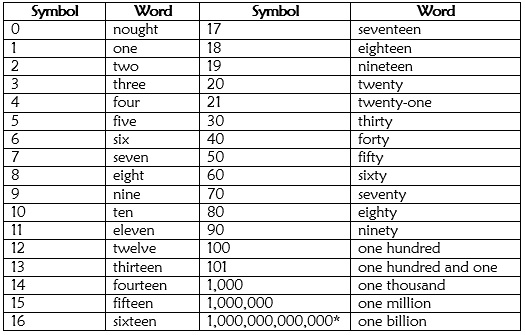
Both in British English and in American English groups of three digits in numerals of one thousand and higher are usually separated by a comma, counting from the right: 4,286; 12,345; 378,925; 6,540,210.
Some manuals of style recommend writing four-digit numerals without a comma: 1570; 2358; 5625.
In numbers written as words in British English, the conjunction "and" is used before tens, or before ones if there are no tens, starting with hundreds: one hundred and twenty-three (123); four hundred and seven (407); three thousand five hundred and thirty-eight (3,538); seventy-three thousand and five (73,005); five million three hundred thousand and fifty (5,300,050).
Note the use of more than one conjunction "and" in large numbers in British English: two million six hundred and twenty-five thousand three hundred and ten (2,625,310).
In American English, the conjunction "and" is generally not used before tens or ones: one hundred twenty-three (123); four hundred seven (407); three thousand five hundred thirty-eight (3,538); seventy-three thousand five (73,005); two million six hundred twenty-five thousand three hundred ten (2,625,310); five million three hundred thousand fifty (5,300,050).
In British English, the conjunction "and" is also used before tens or ones in ordinal numerals above one hundred: one hundred and tenth (110th); three thousand and fifth (3005th). But "and" is not used in American ordinals: one hundred tenth (110th); three thousand fifth (3005th).
Ordinal numerals
Ordinal numerals that can be expressed in one or two words are usually written as words.
Generally, ordinal numerals are used as adjectives and stand before nouns. An ordinal numeral is usually preceded by the definite article "the".
For example:
The first story was interesting. The second was dull.
John Kennedy was the 35th president of the United States.
Here are ordinal numbers in figures and in words:

Difficult spellings
Pay attention to the differences in the spelling and pronunciation of the following cardinal and ordinal numerals.
- two, twelve, twenty, twenty-two - second, twelfth, twentieth, twenty-second;
- three, thirteen, thirty, thirty-three - third, thirteenth, thirtieth, thirty-third;
- four, fourteen, forty, forty-four - fourth, fourteenth, fortieth, forty-fourth;
- five, fifteen, fifty, fifty-five - fifth, fifteenth, fiftieth, fifty-fifth;
- eight, eighteen, eighty, eighty-eight - eighth, eighteenth, eightieth, eighty-eighth;
- nine, nineteen, ninety, ninety-nine - ninth, nineteenth, ninetieth, ninety-ninth;
Note the pronunciation of "five, fifth" and "nine, ninth": five - fifth ; nine - ninth .
Numerals like "eighteen" have two stresses: sixteen ["siks"ti:n]; eighteen ["ei"ti:n]. Depending on the position of the numeral in the sentence, primary stress may fall on the first or on the last syllable.
For example:
He has SIXteen BOOKS. How many? - SixTEEN
.
Numerals like "eighty" have one stress on the first syllable: twenty ["twenti]; sixty ["siksti]; eighty ["eiti].
Note the pronunciation of ordinal numerals like "twentieth": twentieth ["twentiiθ]; fortieth ["fo:rtiiθ]; fiftieth ["fiftiiθ]; seventieth ["seventiiθ]; ninetieth ["naintiiθ]
Fractions
A fraction is a number we need for measuring. When we measure something, such as a length, it will not always be a whole number. Therefore we need numbers that are less than 1, 2 or other figures - numbers that are the parts of these figures: half of one, a third/ a fourth/ a fifth/ a millionth part of some figure. For example:
1/3 means 1 out of 3

The first number in fraction, written before slash (/), is called numerator and is expressed by a cardinal numeral. The second number, written after slash (/), is called denominator and is expressed by ordinal numeral. NOTE: you use ordinal numeral only in oral speech and in fractions written in words, you don’t have to write suffixes “rd, th, ths” in written figures. Therefore, you write 1/5, but you pronounce it and write it in words as one-fifth.
Pay attention that when you write fractions with words, not symbols, you also need to use hyphen (-). For example: 1/7 will be one-seventh. But, when the numerator or denominator is already hyphenated you don’t need to use one more hyphen. For example: 1/25 will be one twenty-fifth, NOT one-twenty-fifth. Here are more examples of fractions, represented by symbols and words:
- 1/2 - one-half / a half; 1/3 - one-third;
- 1/4 - one-fourth / a quarter;
- 1/5 - one-fifth; 1/8 - one-eighth;
- 1/9 - one-ninth; 1/10 - one-tenth;
- 1/12 - one-twelfth; 1/20 - one twentieth;
- 1/32 - one thirty-second;
- 1/100 - one-hundredth;
- 1/1000 - one-thousandth;
- 2/3 - two-thirds; 4/5 - four-fifths;
- 3/4 - three-fourths / three-quarters;
- 5/8 - five-eighths; 9/10 - nine-tenths;
- 7/36 - seven thirty-sixths;
- 33/100 - thirty-three hundredths;
- 65/1000 - sixty-five thousandths;
- 1 1/2 - one and a half;
- 1 1/4 - one and a quarter;
- 3 2/5 - three and two-fifths;
- 6 3/7 - six and three-sevenths.
He has already written three-quarters of his new novel.
A cent is one hundredth part of a dollar.
This box weighs two-thirds of a kilogram.
Decimal fractions
The decimal point (not a comma) separates the whole from the fraction in decimal fractions in English. Decimals are written in figures. When pronouncing decimals we use the word "point" to represent the dot. The numbers following the dot are pronounced separately.
For example:
When you have the number 1.36 we say "One point three six."
The digits to the left of the decimal point are usually read as a cardinal number, and the digits to the right of the decimal point are usually read as separate digits.
For example
, 546.132 can be read as "five hundred forty-six point one-three-two".
Squared/ Cubed/ To the power of
Square numbers are written 2² = we say "Two squared" = 2 x 2 = Two squared equals four.
Cubed numbers are written 2³ = We say "Two cubed" = 2 x 2 x 2 = Two cubed equals eight
You can also say "to the power of" - "Two to the power of two equals four." and "Two to the power of three equals eight."
You can then have "to the power of" any number.
Two to the power of twelve = 2 x 2 x 2 x 2 x 2 x 2 x 2 x 2 x 2 x 2 x 2 x 2 = 4096.
It"s much easier to write 2¹² = 4096.
Interesting numbers
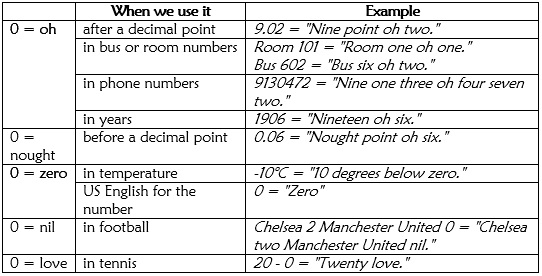
~ 0 ~
There are a number of ways you can say 0 in English.
The number 12 is often represented as a dozen and the number 6 as a half dozen.
For example
:
12 eggs= "A dozen eggs."
6 eggs = "Half a dozen eggs."
A dozen is 12, but a baker"s dozen is 13, because in the past bakers who were caught shortchanging customers could be liable to severe punishment, so they used to add an extra bread roll to make up the weight.
A century is 100. The roman numeral for 100 is C, for centum.
One hundred is the basis of percentages (literally "per hundred"). 100% is the full amount of something.
*~ 1 billion ~
When is a billion not a billion?
In British English billion traditionally means a million million = 1,000,000,000,000 = 1012
In American English billion means a thousand million = 1,000,000,000 = 109
The American billion has become standard in technical and financial use.
However, to avoid confusion it is better to use the terms "thousand million" for 109 and "million million" for 1012.
Milliard is French for the number 109. It is not used in American English but is sometimes, but rarely, used in British English.
Letters as numbers
~ k ~
The letter k is often used to denote a thousand. So, 1k = 1,000.
If you see a job advertised and it offers a salary of £12k it means £12,000.00.
The letter m is often used to denote a million. So, 1m = 1,000,000.
If you see a job advertised and it offers a salary of £12m, apply for it!
The letters bn denote a billion. So, 1bn is usually 1,000,000,000 (see above).
If you see a job advertised and it offers a salary of £12bn, it"s probably a missprint.
The word myriad used to mean 10,000. Nowadays it"s used to refer to a countless number or multitude of specified things.
For example:
Earth hosts a myriad of animals.
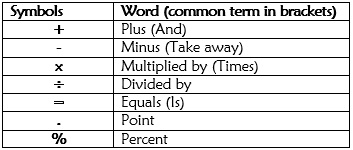
For example:
(((1 + 6) - 2) x 2) ÷ 2.5=4: a) One plus six minus two multiplied by two divided by two point five equals four; b) One and six take away two times two divided by two point five is four.
10% 100=10: Ten percent of one hundred equals ten.
To sum up, next time you talk about math in English, about the maximum speed of your new car, about the weight of that new colleague of yours, or about a part of cake eaten by your friend, you will know which numeral to use, how to spell it and which symbols to use.
If you want to practice all that you’ve read about, follow these links, where you will find different exercises.