Constellation Lyra located in the northern hemisphere of the sky.
This constellation got its name for its resemblance to the lyre, an ancient Greek musical instrument, which, according to different versions, belonged to Apollo or Orpheus.
Constellation Lyra best seen in the sky in summer. At this time of the year, the Lyra is visible from all over Russia. In early autumn, it is also clearly visible in the first half of the night.
The five stars of the constellation Lyra are clearly visible in the sky and form a small figure that stands out well in the sky.
The brightest star in the constellation Lyra is a little away from the main quadrangle - this is the star Vega, also known as alpha Lyra (α Lyra). Vega is one of the three stars of the Summer Triangle known to many, which consists of Vega, Deneb (α Cygnus) and Altarira (α Eagle).
The star Vega is the fifth brightest star in the sky. It is the most studied star in the sky.
In the sky of our country, Vega is the third brightest star after Sirius and Arcturus.
Vega - is located 25.3 light years from the Sun, its apparent magnitude is 0.03 m. The spectral type of Vega is A0Va (a white star).
The brightest stars constellation Lyra:
Vega (α Lyr, alpha Lyra) - 0.03 m - white star of class A0Va.
Sheliak (β Lyr, betta Lyra) - 3.32 m - a bright blue-white eclipsing variable star of class B7V.
Sulafat (γ Lyr gamma Lyra) - 3.35 m - blue-white giant of class B9III.
δ² Lyra, Lyra delta - 4.42 m - bright red giant, M4IIvar class variable.
R Lyra or HR7157 - 4.48 m - red giant, semi-regular variable of class M5IIIvar.
About the star ε Lyra, epsilon Lyra - 4.67 m it is worth mentioning separately - this is a very interesting star located 162 light years from Earth.
Even with binoculars, it is already divided into two components, separated by 3.5 "(arcminutes) - northern ε 1 and southern ε 2
But, it's not just a binary star system. Each of these components, in turn, consists of two stars separated from each other by 2.8 "for ε 1 and 2.2" for ε 2 (" - arcseconds).
That is, it is not a double, but a quadruple star. And if the mutual angular distances of these four stars are well known, then you can quite accurately determine the characteristics of your telescope.
Were you able to see all four stars? - means the equipment is well adjusted! 
Epsilon Lyrae is a great tool for determining the resolving power of your telescope!
"How so?" - You will say, - "If the stars revolve around each other, then the angular distances also change!"
That's right, but the fact is that the periods of these rotations are very long and within the limits of one human life it can be said that the mutual angular distances are almost constant. ε 1 and ε 2 revolve around each other with a period of 244 thousand years. The orbital period of the ε 1 components is 1200 years, while those of ε 2 are 720 years.
What a great use for the little constellation Lyra!
In the constellation Lyra, the most famous object in deep space is the Ring Nebula or M57. It seems to be easy to find it - between two "lower" stars.
Therefore, M57 was the first nebulous object that I unsuccessfully tried to see through binoculars, and of course found nothing. Only later did I read that nebulous objects are quite dim and can be seen worse than the surrounding stars. In addition, M57 is not visible through ordinary binoculars - this requires an aperture (telescope diameter) of at least 80mm. and if you want to see the M57 in the form of a ring, with a dark center, then you need at least 130-150mm and a magnification of about 80-90x.
In general, a slight decrease in brightness towards the center is already visible at 100mm, but only if you know that it is there :), or if you set a large increase, for example, using a Barlow lens, at the cost of a large loss in the brightness of the picture as a whole.
There is also a slightly more accessible object in the constellation Lyra - the globular cluster M56. Theoretically, it can also be detected with binoculars - at a brightness of 8.8 m, it should be visible in the form of a foggy speck. But, alas, against the background of the Milky Way, this balloon is "lost". However, with a good dark sky, you may well detect a small cloudy speck with binoculars.
With a 150mm telescope, M56 is already clearly visible, but I managed to break it into separate stars only in a "dobson" with an aperture of 250mm. The reason for this is not only the Milky Way, against which much is lost, but also the fact that the globular cluster itself is rather loose, with a small concentration of stars.
As you can see, both deep sky objects in the constellation Lyra are not very visible without at least a medium telescope. Nevertheless, it is a sin not to look in the vicinity of the constellation Lyra, because it is located in the near-zenith region, where the sky is the darkest. In addition, all this is available in the warm season. Besides:
If you're testing equipment, then the bright star Vega is well suited for this purpose - it is one of the first to appear in the evening sky.
And when Lyra's epsilon appears, there will be no better object for testing!
Other objects in the Lyra Constellation are visible only in telescopes of large apertures, from 250-300mm and in a black sky (without street lighting).
Constellation Lyra You can see it best in summer, but you can see it quite well in the early autumn in the evening. Finding the constellation Lyra is quite simple. In the middle lane in the summer, around midnight, Lyra is almost directly above you - in the near-zenith region. It is quite easy to recognize him by outlines.
But, you can do as shown in the figure: find the "big northern cross", that is, the constellation Cygnus, and look in the direction shown in the figure below - look for the brightest star, and below it is the already familiar oblique quadrangle. As you can see, finding the constellation Lyra is as easy as shelling pears. Just in case, I captured a large patch of sky with the Big Dipper bucket.
Constellation Lyra - interesting facts
>Constellation Lyra stood out in the sky by many ancient peoples. This is not surprising - the five stars of the Lyra constellation are located quite compactly, in addition, there are no other bright stars in the immediate vicinity, so the Lyra constellation stands out well in the sky.
In the astronomy of ancient Egypt, the constellation Lyra was depicted as a vulture, and in ancient India - as an eagle or vulture. This is a very curious similarity in the mythology of the two countries. One could assume the existence of a common ancient myth, which is especially interesting, given the large distance from India to Egypt - a random coincidence of characters looks unlikely. But, alas, this ancient myth is lost and we only know the later ancient Greek myth about the kite of the god Zeus, who stole a victim for him from the hands of the titan Briareus. Therefore, in old maps, Lyra is often depicted in the claws of a kite.
By the way, in Arabic, Vega means "falling kite."
Romanians call the five stars of the constellation Lyra "Shepherd with sheep." Here Vega is a shepherd and the other four stars are sheep.
It is curious that the ancient Incas on the other side of the world, in South America, also identified the constellation lyre with cattle. They believed that these five stars protected their cattle and made sacrifices to the constellation Lyra.
or tell your friends:Whatever Lyra has been (like most constellations) over the years of its existence. Today we see her as the Lyre, a harp-like stringed instrument that was given to Orpheus, the musician of Jason's intrepid band of Argonauts. On old maps of the starry sky, you can see Lyra in the form of a turtle or a vulture. At the top of Lyra shines the 5th brightest star in the night sky - the snow-white pearl Vega. Together with Deneb in Cygnus and Altair in Orel, Vega forms one of the most famous asterisms (i.e., recognizable groups of stars) in the summer sky - the Summer Triangle.
Vega, Kappa and Double double.

Vega, Kappa and Double double. Search card.
We'll start with the most recognizable star in the constellation. It is one of the few "movie stars" in the sky, with a recorded magnitude of 0.03. Vega is eclipsed only by Sirius, Canopus, Alpha Centauri and Arcturus. Due to precession (wobble of the earth's axis), about 14,000 years ago, Vega was the North Star, and will be again in the distant future. Tonight, let's just look at the snow-white color of the star.
If you're using a refractor, Vega is the perfect test for color grading. An achromat will show Vega surrounded by yellow, green and/or purple, while a true apochromat will show it as pure white. This "false color" is due to the design of the refractor and is called chromatic aberration. But don't be discouraged if your telescope isn't perfect. Most of them are. In addition, besides the optics of telescopes, there are other factors that cause color distortion. From time to time a slight false color can be seen even in a reflector!
Then let's fast-forward five degrees west-southwest to pale yellow Kappa Lyrae at magnitude 4.33. With binoculars or a telescope with a wide-angle eyepiece, you can get used to seeing Vega and Kappa in the same field of view. Take a moment to compare the colors of these celestial bodies. Kappa is in spectral class K, which means it emits a deep yellow-orange color and glows at a temperature of 3950-5250 kelvins. (Those of you who didn't fall asleep in school physics class may remember the mnemonic rule for memorizing spectral classes:ABOUT din B crushed A Englishman F iniki AND eval TO ak M orc ( O hB e A F ine G irl K iss M e). True, since then, at the end, more have been addedL And T ). Vega is a star of spectral class A, which is characterized by a white color and a temperature of 7100 - 9500 K on the surface, it is much hotter than Kappa.
Now let's jump down to Epsilon Lyrae - Double Double (E1 - m5.6/m6.02, E2 - m5.14/m5.37). This is a classic summer target for small telescopes. As the name implies, this is a wide double star, the components of which are also double! Many hobbyists use Double Double as a test for their telescopes and eyes, looking for the lowest magnification that will allow Epsilon to be broken down into its components. A wider pair is separated simply, a closer one is more difficult. My personal best is 66x, but I've heard credible reports of people sharing it at 57x as well, though 80+ is a bit more common. And how will it work out for you?
Lyra Delta

Let's continue moving counterclockwise through the constellation and take a closer look at the colored multiple star Delta Lyrae. Here is a great contrasting pair for small telescopes and binoculars. Delta1 (magnitude 5 / spectral type appears light blue), while Delta2 (magnitude 4.5 / spectral type M) appears pale orange. Examine Delta 2 closely and you will see that it has a dim (magnitude 11+) companion - in fact, it's two in one!
While you are in this area, it is quite possible to observe the sparse open cluster Stevenson 1 (Stephenson 1, about 15 stars from 4th to 10th magnitude). Can you distinguish it?
M57 - The Ring Nebula
M57 was discovered in January 1779 by Antoine Darquier de Pellepoix. The ring was the second planetary nebula to be discovered, the first being M27. According to the SEDS website, Charles Messier discovered and cataloged M57 only a few days later than Darke. Messier described it as "a dim but superbly defined nebula; as large as Jupiter and like a hazyplanet". Therefore, Messier was the progenitor of the name "planetary nebula".
I was able to capture the Ring in 15x70 binoculars, but in order to fully appreciate the structure, you will need a small telescope and medium power (80x-120x). Even the smallest telescopes show the structure of the magnificent ring. Like most planetary nebulae, M57 has a very high surface brightness and responds well to magnification. So add an increase as soon as you notice it in this area, and watch for changes.

Another challenge for amateurs is to try to identify the central star in this summer gem. Despite the fact that its recorded value is something around 14, in reality it is much more difficult to distinguish it than one might think. There is some speculation regarding the variability of the central star, but most astronomers suspect that the gas in the center of the ring weakens the contrast and thereby limits the magnitude. The smallest telescope I have seen the central star through is 10" f7.5 at 700x, which is considered absurdly high in typical situations. So far, you may have heard that most astronomers use low power - and this is common for most observations. However there is a time and place when you should break this rule, it all depends on your ability to see and the object of observation.Planetary nebulae are just such a type of object.Use a significant increase - you will be surprised at the result!
M56
Our next destination is M56 (also cataloged as NGC 6770), located midway between Sulafat (Gamma Lyrae) and Albireo (Beta Cygnus).
Messier discovered it on January 23, 1779 and described it as "a nebula without stars". Now, many years later, most amateurs will tell you that this is certainly not the case. It may not be the brightest example of a globular cluster (like M5 or M13), but M56 is undoubtedly a nice addition to Lyra and another Messier object located in the constellation.

At magnitude 8, M56 is a fairly easy target for binoculars - if you know where to look. But in a telescope it is truly beautiful. It has a relatively high average surface brightness, which interferes significantly with magnification, so if you're aiming to resolve clustering on individual stars, use medium to high gain (150x-200x). If you have access to telescopes of various sizes, the cluster can be a good target for aperture experiments. What is the smallest telescope that will allow you to resolve the cluster into individual stars? At what magnification will the stars start to stand out?
As you add magnification, look for the appearance of irregularities at the outer edges, and see when the arms and core begin to appear to break apart into individual stars. In 8" and larger telescopes, this globular cluster has an excellent view.
Complex object: NGC6765
And finally, here's a tougher challenge for those who are going to push equipment, terrain and skills into battle more seriously; NGC6765.
Rudolf Minkowski classified it as a planetary nebula in 1946. This small, faint nebula lies 1/4 the distance between M56 (NGC 6779) and Sulafat (Gamma Lyrae) and can be a difficult target for an 8" telescope under decent skies. It has a recorded magnitude of around 12.9 no catalog of magnitudes), and the central star is magnitude 16. Reports show that the nebula is somewhat elongated along the northeast–southwest axis, with a star of magnitude 14 located exactly to its northeast.

The nebula is tiny and faint, so use high magnifications and an OIII or UHC filter (if available) to boost the contrast and increase your chances of making it stand out. For those who don't know what these filters are, they are essentially specially designed filters that allow only certain wavelengths to pass through the eyepiece, thus helping to eliminate stray and unwanted light. The planetary nebula is particularly responsive to the OIII filter, but if you have a small scope, you might want to consider using a UHC filter instead of OIII.
Another trick when looking for dim objects: when you've set the field of view, you think the object is there, but you can't pick it out, try tapping on one side of the telescope to cause the tube to move very lightly. Very often this helps to make a dim target visible.
Photos DSS. Copyright
http://archive.stsci.edu/dss/acknowledging.html
Helpful information:
The Art of DSO Observation
No less beautiful constellation Swan, and hid between them. This is a small, beautiful, memorable and accessible constellation for observation both in binoculars and in a telescope. The first deep sky object that pops up in memory at the mention of the constellation is the planetary nebula "Ring" ( M57). But the constellation is rich not with one "ring". About everything in order.
Legend and history
>A very old constellation. Included in the catalog of the starry sky by Claudius Ptolemy "Almagest". It got its name in honor of the lyre of the son of the god Apollo - the ancient singer Orpheus. Orpheus was very fond of the nymph Eurydice (wife) and after her death followed her into the kingdom of the dead Tartarus. There, Orpheus captivated Cerberus, Charon and the god of the dead - Hades with his game. Hades allowed Eurydice to leave the kingdom with her husband if she promised to always follow him, and Orpheus would never look back. But Orpheus could not cope and looked around. The wife remained in the realm of the dead forever. Grief overtook Orpheus, he wandered through the mountains and forests for days and nights, playing the lyre. Once I met a group of Bacchantes - priestesses of the cult of Dionysus. Intoxicated with wine, the women seduced Orpheus and tore him apart. His body was buried in Thrace, and his head was taken to the island of Lesbos. After all that had happened, the god Apollo placed the musical instrument lyre in the sky.
Characteristics
>The most interesting objects to observe in the constellation Lyra
>1. Planetary nebula "Ring" (M 57 or NGC 6720)
>
The amazing "heavenly eye", looking at us from the depths of space, conceals in the very center a very hot blue star, the temperature of which is close to 100 thousand degrees Celsius. The nebula is best observed in a telescope with an aperture of 200 mm, but even in 150 mm units it will be possible to see a small foggy disk and a dark core. M57 continues to expand at a rate of just over 1″ per century, which is of course imperceptible to the observer. Brightness - 8.8 m , angular dimensions - 2.5' × 2'. The distance from us to the nebula is 2100 light years, in some sources you can find the number 4100. The radius of the ring is a third of a light year. The age of the nebula does not exceed 10 thousand years. Today it is one of the most "photogenic" objects in the universe. It is especially pleasant to distinguish color shades in amateur photographs that cannot be seen through a telescope. A beautiful photograph from NASA confirms the beauty of the "planetary" ( Click to open full size in a new tab):
2. Globular star cluster M 56
>
M56 is the brightest globular cluster in the constellation Lyra. It has a brightness of 8.3 m and a visible size of 8.8'. The diameter of the cluster is about 80 light years (in some sources you can find the number 60). It is removed from the Sun at a distance of a little more than 30 thousand light years (again, different values \u200b\u200bin different sources). The discrepancy in the measurements is most likely due to the inaccuracy of the calculations, that is, the cluster was not observed for a long time so that the exact characteristics could be determined due to the shift and change in the spectral characteristics.
Already in 130 - 150 mm telescopes M56 can be studied in detail. Of course, it has not yet broken up into stars, but it will be possible to consider a saturated core and an inhomogeneous structure along the edges. In a telescope with a primary mirror diameter of 200 mm or more and at high magnification, the “ball” begins to break up into stars. Despite the seemingly difficult route to the cluster, it is located quickly by reference bright stars of 4 - 5 magnitude, even with an 8x finder.
3. Open star cluster NGC 6791
>The Wisest Oldest (about 8 billion years old), a large open cluster studied in detail NGC 6791 has a brightness of 9.5 m, an angular diameter of 16 ′ and is removed from us at a distance of about 20 thousand light years. The open cluster includes about 100 stars, among which white dwarfs older than 6 billion years old have been found.
When viewed through an eyepiece with a small magnification, an open cluster looks like a weak and small globular cluster, but when you change the eyepiece to a more “powerful” one, it becomes clear that the cluster is open. Due to the many stars of magnitude 10-13, it is extremely difficult to distinguish the boundaries of the desired object against the background of the cluster and clearly distinguish it against an inhomogeneous background.
4. Double star β Lyr
>Beta Lyrae belongs to the class of multiple stars. This is a unique class of stars whose brightness changes throughout time due to the strong deformation of the components and their mutual illumination. The period of the system is 12.9 days, and the brightness (brilliance) of the star changes from 3.4 to 4.3 m.
At a distance of 46″ there is another star with an apparent magnitude of 7.2m, which in turn is a spectroscopic binary. However, it is believed that the last pair of stars does not belong to Beta Lyrae, but is only an optical binary. The distance to this group of stars from the Sun is 1300 light years.
5. Multiple star ε Lyr
>Epsilon Lyrae is a multiple star, consisting of four components, which in turn are divided into pairs. The distance between the pairs is huge (by the standards of cosmic values) - 173″ and is accessible for observation even with astronomical binoculars. Components or they are also called ε 1 (North) and ε² (South) - white stars. This system has been studied in great detail to date. The orbital periods are determined quite accurately. So, for example, the orbital period ε 1 and ε² is a little more than 240 thousand years. The angular distance between the stars of the Northern component is 2.3″, and between the stars of the Southern component is 2.6″. It will be possible to notice the gap between the stars only in a professional telescope with an aperture of 250 mm and at the maximum allowable magnification. On the atlas above, I noted and signed the location of multiple stars: to the right of ε Lyr is the brightest star in the constellation and the second brightest in the Northern Hemisphere - Vega.
In conclusion, I will say a few words about Vega. It is the second brightest star in the Northern Hemisphere (after Arcturus in the constellation), the fifth brightest star in the entire night sky. It is located at a distance of 25.3 light years from the Sun and exceeds our star by almost 3 times in mass. Refers to white stars and lies on the main sequence or spectrum-luminosity.
This completes the acquaintance with the musical instrument, the constellation Lyra. I am sure that you will repeatedly point your telescopes or binoculars to it, you will try to detect as many details as possible in the planetary nebula "Ring" ( M56), resolve multiple stars into separate components and just enjoy this part of the sky!
P.S. About how it is better to observe this or that object of deep space: whether it be a galaxy or a star cluster, or a nebula - read the relevant articles, the list of which is given below.
All articles in the series "Observations of deep space objects".
In summer, the sky on cloudless nights is especially beautiful. It seems that the number of flickering dots overhead after the winter has increased many times over. In the northern hemisphere, almost in the middle of the celestial dome, right above the crown of the observer, you can see a fairly bright star. This is Vega, the alpha of the constellation Lyra, a small celestial figure located in such a favorable place from the last days of spring to the middle of autumn. The image of an ancient musical instrument, despite its modest size compared to its neighbors, has attracted the eyes of astronomers since ancient times.
Environment and form
>The constellation Lyra contains 54 luminaries visible from Earth with the naked eye. Her closest neighbors in the sky are Cygnus, Hercules, Dragon and Chanterelle. Finding the brightest point of the picture, Vega, is quite easy, not only because of its position. Alpha Lyrae is one of the peaks of the Summer Triangle asterism, which consists entirely of very bright and highly visible stars. Its other two corners are marked by Deneb of and Altair, referring to the celestial representation of the Eagle.

The shape of the constellation Lyra resembles a quadrangle, all the peaks of which are clearly visible on a clear night. Vega is located at a small distance from one of them.
Constellation Lyra: legend
>As you know, this heavenly drawing bears the name of an ancient musical instrument. In ancient Greece, lyres were made from tortoise shells. In honor of the animals, the instrument was named: the word "lyre" in translation means "tortoise". According to legend, the first such object capable of making melodic sounds was presented to people by Hermes. Lyra always accompanied the mythical singer Orpheus. According to legend, his music and voice captivated both gods and people. Where the sounds of the lyre were heard, flowers bloomed and birds sang. Orpheus had a difficult fate: he lost his wife, Eurydice, went down to the kingdom of the dead after her, tried to return her, but at the last moment violated one of the main conditions of Hades. Having lost his beloved, Orpheus threw away the lyre and left in silence and sorrow to live out his life. The gods, in awe of the sounds of the instrument, took it to heaven and made it a constellation.

lovers
>The star Vega is associated with a separate legend of eastern origin. Japanese and correlates it with the beautiful goddess who fell in love with a mortal. The young man is also placed in the sky: this is Altair from the constellation Eagle. The father of the goddess, who found out about secret love, became angry and forbade his daughter to meet with the chosen one. Since then, Vega and Altair have been separated by a celestial river, the Milky Way. Lovers are allowed to meet only once a year, on the seventh of July, when thousands and forty build a bridge between them. At the end of the night, the goddess comes back and mourns the separation with bitter tears. Salty drops are seen from the Earth as falling meteors, Perseids.
Alpha
>The brightest star in the constellation Lyra has long attracted not only the eyes of storytellers. Scientists have always been interested in it. The unique position of the star and its visibility led to the fact that today Vega is one of the most studied stars in space.
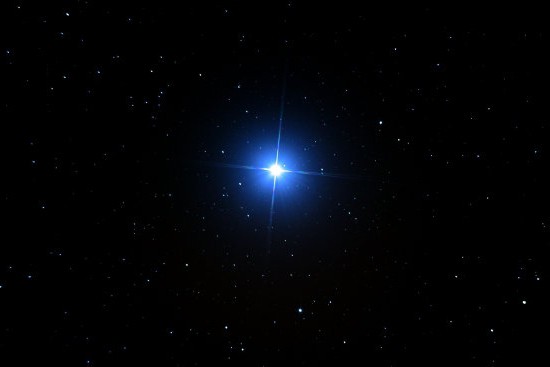
In terms of brightness, it ranks fifth in the entire sky and second in the northern hemisphere after Arcturus. Visible Vega - 0.03. It belongs to the objects of the spectral class A0Va, its mass exceeds the solar one by 2.1 times, and its diameter is 2.3.
The future of the luminary
>The star Vega is a blue-white giant. According to scientists, it has been shining for 455 thousand years. For a person, this is an amazing figure, but by the standards of the Universe, Vega does not live that long. For comparison, the Sun has been illuminating our section of the Galaxy for 4.5 billion years. The intensity of radiation and other characteristics will not allow the main star of Lyra to exist for such a long time. Astronomers predict Vega extinction and destruction after about another 450 thousand years.
Standard
>Due to its position, Vega is well studied, which, in turn, served to establish it as a certain standard in astronomy. Since the middle of the 19th century, the stellar magnitudes of several hundred luminaries have been determined from its brilliance. Vega became one of the seven stars located at such a distance from the Sun that cosmic dust does not distort the radiation coming from them, on the basis of which the UBV photometric system was perfected, which makes it possible to determine some of the physical parameters of the luminaries.
Despite the seemingly comprehensive study of Vega, there are a number of related questions that have not yet received exhaustive answers. One of them undermines the "reputation" of alpha Lyra as a standard in astronomy. In the last century, "malfunctions" in the brightness of the star were discovered. The data obtained indicated that it fluctuated. In this case, Vega should be attributed to variable stars. So far, there is no unequivocal opinion on this matter.
Rotation
>In the 60s of the 20th century, the usual definition of the spectral type of Vega was also called into question. It turned out that Lyra's alpha is too hot and bright for the standard representatives of her type. The fact did not receive a worthy explanation until 2005, when the solution was found.
It turned out that Vega rotates around its axis at high speed (near the equator, the figure reaches 274 km / s). Under such conditions, the shape of the space object changes. Vega is no more or less a regular sphere, but an ellipse, elongated along the equator and flattened at the poles. As a result, contrary to usual, the northern and southern outskirts of the star are located closer to the hot core than the equatorial zone. The poles heat up more strongly, glow brighter.
This hypothesis arose in the 1980s and was confirmed by observations in 2005. It explains both the anomalous and its brightness.
Disk
>Vega is characterized by another feature: it has a circumstellar dust disk. She became the first luminary in which such a formation was discovered. The disk consists of the remnants of space objects that collided with each other near the star.
The discovery of the disk was preceded by the detection of an excess of infrared radiation from Vega. Today, all luminaries with a similar characteristic are designated as "vega-like".
Some features in the structure of the dust disk suggest that a huge Jupiter-like planet revolves around Alpha Lyra. While this data is not confirmed, but if it happens, Vega will become the first brightest star to have a planet.
Sheliak
>
Among the interesting objects of the celestial musical instrument is not only Vega. The constellation Lyra has several multiples The attention of scientists is primarily attracted by Sheliak, the beta of Lyra. It belongs to the eclipsing variable luminaries. The system consists of a bright blue-white dwarf and a large but dimmer main-sequence white star. They are separated by 40 million kilometers, which is very small by space standards. As a result, the substance from one of the partners continuously flows to the other.
The gas moving from the "donor" forms an accretion disk around the "recipient". At the same time, both stars are surrounded by a common gaseous shell, which constantly gives off part of its substance to the surrounding space.
Initially, the ratio of the masses of the companions looked different. Today's donor was more impressive. Over time, he turned into a giant and began to give his substance. Now its mass is estimated at 3 solar masses, while this parameter for a companion is 13 masses of our star.
At some distance from the main pair, there is a third star, Beta Lyra B. It is 80 times brighter than the Sun. Beta Lyrae B is a spectroscopic binary (the period is 4.34 days).
Epsilon
>The constellation Lyra also has a star system consisting of four components. This is Epsilon Lyrae, splitting into two components Epsilon 1 and Epsilon 2 even when viewed with binoculars. Each of them is a pair of luminaries. All four components are white stars belonging to the same spectral class as Sirius. Epsilon 1 and 2 rotate with a period of 244,000 years.
Ring and ball
>Almost any celestial drawing can boast of beautiful nebulae in its "territory". The constellation Lyra is no exception. A photo of a space object located between gamma and beta Lyra gives a clear idea of the origin of its name.

The Nebula Ring, in its shape, really resembles the corresponding piece of jewelry. It adorns the constellation Lyra, located at a distance of 2 thousand light years from Earth. The age of the nebula is estimated to be 5.5 thousand years. You can see it with binoculars. The beautiful glow of the nebula is due to the ultraviolet radiation emitted by the white dwarf. It was once the core of a massive star.
Not far from the nebula is the globular M56.
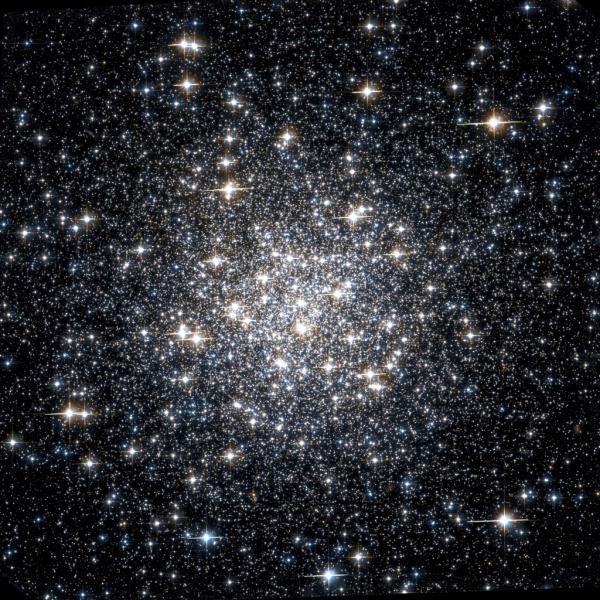
Their neighborhood, however, is imaginary: M56 is 32.9 thousand light years away from the Earth. In the pictures, it resembles a ball, compacted towards the middle, where the number of stars per unit of space is quite high. There are approximately 12 variable stars here. The globular cluster is difficult to observe with amateur equipment because it is lost in the background of the Milky Way.
Lyra is a small constellation, but interesting nonetheless. On its "territory" there are representatives of very many objects from among those that are studied by astronomy. The stars and constellations surrounding Lyra may seem more imposing and noteworthy. On the other hand, bright Vega alone is enough to “outshine” them all. Especially if we remember that the stellar magnitudes of these luminaries, quite possibly, were determined on the basis of data on Lyra's alpha. This heavenly drawing, therefore, is a clear illustration of the saying "small and bold." However, the same can be said about his legendary prototype, the lyre of Orpheus.
The constellation Lyra is a small but very pretty constellation that occupies approximately 286.5 square degrees in the sky. With the naked eye, 75 stars can be easily distinguished in this constellation. One of the brightest stars is. If you outline the cluster of stars that are part of this constellation, then a parallelogram will appear - a characteristic figure of this constellation.

Screenshot from the planetarium program
The constellation Lyra is visible at mid-latitudes almost all year round. Only occasionally does it hide behind the horizon, but even during these periods it can be seen either at dawn or at sunset. The best time to see Lira is from May to October. It refers to small constellations. But, despite their size, they are not inferior to others, more massive, in beauty and saturation with interesting objects. The closest constellations with which to find Lyra are Cygnus, Chanterelle, the "head" of the Dragon and Hercules.
The constellation Lyra is small in size, but very full of beautiful and interesting objects. Here is one of the brightest stars in our night sky - Vega. You can also find binary systems. , variables - all these objects can be found in the constellation.
Stars
>
A star that has magnitude zero. The fourth brightest luminary in the night sky. It is located at the top of the parallelogram. Vega belongs to the blue giants and has a diameter twice that of our Sun.
Journey to Vega
The distance of this giant from our star is about 27 light years. Serves as a reference if the question concerns color, brilliance or brightness. Historical note: This is the very first star to be measured in 1837. This was done by the Russian astronomer V. Ya. Struve.
Briefly about Vega

One of the most interesting stars. Its notability is that it is an eclipsing star and is a variable. It is surrounded by a gas-dust ring and has an expanding shell.

A binary system, the constituent elements of which can be easily distinguished with the naked eye. If you use a telescope with 100x magnification, you can see the remarkableness of this system. Each of the elements is itself a binary system. Having studied these stars in more detail, astronomers discovered that one of them is also a binary system, only very close. Thus ε is a fivefold system.

Semiregular variable. Her periods between two outbreaks are always slightly different.

A short period Cepheid that can be easily seen with ordinary binoculars.
meteor showers
meteor shower

In the constellation Lyra there is a meteor shower radiant, in which up to 10 meteors are observed per hour.
The location of the M57 nebula in the sky
Hubble's view of the M57 nebula

If you look closely through a telescope, you can see a planetary nebula between the stars β and ε. It has the name M57.
3D structure M57
Story
>
Constellation Lyra, drawing from an old sky atlas
Lyra is a very ancient constellation. Included in the catalog of the starry sky of Claudius Ptolemy under the name "Almagest". Being the most favorite musical instrument of the ancient Greeks. But a constellation was drawn in the form of a kite (Vega - a falling kite), which holds a lyre in its paws.