Modern society makes more and more demands on the individual. In order to be successful in modern society, a graduate of a school or university must not only have a number of subject knowledge, skills and abilities, but also be an active, creatively developed personality capable of quickly finding non-standard solutions to emerging problems.
One of the features of a foreign language in teaching is that it can simultaneously act as both a goal and a means of learning, thus being an ideal basis for the development of students' creative abilities in parallel with their acquisition of language knowledge, skills and abilities. The use of heuristic methods in a foreign language lesson can contribute not only to the formation and development of creative and communication skills of students, but also to activate the studied lexical and grammatical material. Taking into account the requirements of the modern Federal State Educational Standard of basic general education, we propose the introduction of the following methods into the educational process when teaching vocabulary at the senior stage of education.
What is heuristic learning? Innovative teaching methods. Among the innovative teaching methods, heuristic learning is distinguished, the prototype of which is the method of questions and reasoning of Socrates, or, in other words, “Socratic irony”. It is known that the ancient Greek philosopher led his students to a true judgment through dialogue. He first asked a general question, and having received an answer, he again introduced a clarifying question, and so on until a final answer was received.
Khutorskoy A.V.: Heuristic learning aims to construct the student's own meaning, goals and content of education, as well as the process of its organization, diagnosis and awareness. The student's personal experience becomes a component of his education, and the learning content is created in the process of activity.
Heuristic activity is sometimes associated with creative activity. However, the first concept is broader and has a number of differences:
1. Heuristic activity includes the creative processes themselves to create educational products.
2. One of the components of heuristic activity is the cognitive processes that are necessary to accompany creativity.
3. In heuristic activity, organizational, methodological, psychological and other processes provide creative and cognitive activity.
The main task in heuristic learning is the creative self-realization of the student. This is done in the following way. The student receives material for construction, but he is not given ready-made knowledge about it. He creates a product of activity (a hypothesis, an essay, a craft), and then, with the help of a teacher, compares it with historical analogues in this area. As a result, the student rethinks his result and his personal transformation takes place (a change in feelings, knowledge, abilities and experience).
The result of the student's activity can also be a general cultural increment, when the student is involved in cultural and historical processes. The heuristic educational situation is a key element of learning. This situation activates ignorance, its purpose is the birth of a personal idea, problem, hypothesis, scheme, text, etc. by the students. The educational result in heuristic learning is unpredictable, each student can get completely different results.
Heuristic learning is based on open tasks. Almost any element of the topic under study can be expressed in the form of an open task.
Today in our master class, I want to introduce you to some heuristic methods.
As I already said, heuristic teaching methods are those that always result in educational products created by students: an idea, a hypothesis, a text work, a picture, a craft, a plan of their classes, etc.
The first method we will be introduced to is the empathy method.
The empathy method means “feeling” a person into the state of another object, “settlement” of students in the studied objects of the surrounding world, an attempt to feel and know it from the inside.
For example, get used to the essence of a tree, a cat, a cloud and other educational subjects. At the moment of getting used to, the student asks questions to the object-self, trying to perceive, understand, see the answers on a sensual level. The thoughts, feelings, sensations that are born at the same time are the educational product of the student, which can then be expressed by him in oral, written, pictorial form.
And now I will ask you to break up with the help of color into teams of 3-4 people.
teacher: Imagine yourself that you are ‘Tornado’. How can you describe yourself, what are your feelings? Name your adjectives, verbs, your favorite season, places you occur, your weather.
(5 minutes are allotted for work) Then each team reads out their resulting stories.
Teacher: and here is an example that the student got
student:- I am Tornado. I am the most terrible of all storms. I am dangerous, violent, strong, cruel, noisy and destructive. I destroy houses, carry away cars and telephone boxes. I occur in the springs, throughout the world, but mostly in the United States, especially in the central states. I occur in the afternoon or in the early evening in a hot day. Large clouds appear in the sky. They become darker and darker. The sounds of thunder, bright flashes of lighting! I form a funnel and begin to twist. My funnel touches the ground, it picks up everything it can.
Next method: Method "Mind-Map" (Memory Map). This method is somewhat similar to the "cluster" method in critical thinking.
“Mind-Map” Method is a simple technology for recording thoughts, ideas, conversations. Recording is fast, associative. The topic is in the center. First there is a word, an idea, a thought. There is a stream of ideas, their number is unlimited, they are all fixed, we begin to write them down from the top left and finish at the bottom right.
The method is an individual product of one person or one group. Expresses individual capabilities, creates space for the manifestation of creative abilities.
Possibilities of using “Mind-Map”
- When systematizing, repeating the material;
- When working with text;
- When repeated at the beginning of the lesson;
- When introducing a topic;
- When collecting the necessary language material;
- Under control.
Task for groups:
Brain Storming Method
By brainstorming, students name everything they know and think about the topic, problem. All ideas are accepted, whether they are correct or not. The role of the teacher is that of a guide, forcing students to think while listening carefully to their considerations.
Property list method
The method consists in dividing the subject or idea into key constituent properties. The properties of an item may include its size, shape, taste, color, weight, smell, contents, packaging, and so on. Determining the key properties and decomposing an object by its properties allows you to consider the object in more detail and, working with each property separately, produce a new, more advanced product or idea. According to A. J. Starko, the property list method can be applied to any academic discipline and for any age of students.
Example: Divide into groups of three. Each group will get a picture of different kinds of vehicles. You are to discuss the main qualities of the vehicle and make a list of them. Then you'll have to think of one quality that can be changed to make the vehicle better. What will that be? What will the change bring? Present the updated kind of transport to the other groups.
Exclusion method
Students are presented with three objects, actions, numbers, concepts, etc. and it is proposed to exclude the superfluous, while explaining the choice. This method implies such a method of mental activity as a comparison, thus allowing a more detailed knowledge and understanding of the studied material or problem.
Example: Look at the given pictures (road, sky, water; plane, car, bus; run, climb, jump; etc.). You are to choose the wrong one. Explain your choice.
Method of taking into account the views of other people
The method is used when the analyzed problem involves consideration of it from different points of view. The ability to put yourself in the position of another person and look at the problem through his eyes allows you to identify aspects of the problem that have not been taken into account before.
Example: A plane that was supposed to deliver a family of three (mother, a ten-year-old son and a five-year-old daughter) that was traveling to Moscow had to make an emergency landing in Paris. The family spent for days in the city. Describe everything as if you were: the mother, the son, the daughter, the pilot of the plane, a travel agent, a taxi driver, the father of the family.
Forbidden word method
Students are encouraged to define objects or ideas, but without using common words and phrases. This method allows you to expand vocabulary, and also trains the ability to find analogies and give examples.
Example: Describe the object that you see in the picture (plane ticket) without using the following words: a plane, a ticket, transport, holidays, fly, air, a stewardess, a pilot.
Idea game method
Considering various ways of formation and development of creative abilities, A. Cropley offers the so-called method of playing with ideas. This method implies a variety of logic games, the essence of which is preparation for mental activity, a kind of exercise for the brain, during which strategies of mental activity are mastered.
Games take several minutes and can take place at the beginning of the lesson as a speech exercise, or be included in the educational process in connection with the development of new material or understanding the essence of the problem presented by the teacher. The “playing with the idea” method can be implemented through the following techniques:
– production (creation): in the process of implementing this technique, students need to put forward an idea related to the problem presented, for example, give a list of abbreviations that should be deciphered in such a way that they are relevant to the topic of the lesson;
Example: Reveal the meaning of the following abbreviations in connection with the topic of the lesson (travelling): BBC, RAF, FBI, NATO.
– analysis : represents a clear definition of the content of an object or idea and can be implemented, for example, by providing students with a list of materials and asking them to name as many ways as possible to use them, including non-standard ones;
Example: Think about all possible variants of the usage of the following objects: credit card, sun lotion, suitcase, flippers, passport.
– improvement : development of a detailed structure based on leading features, for example, students are voiced the leading principles, and are invited to describe an object, moreover, an object that does not currently exist, but is theoretically possible and expedient;
Example: Describe in detail a means of transport that can travel rather fast my road and by air, take more than five people aboard and be environmentally friendly.
– sharpening of attention : identifying key aspects of objects and ideas, for example, asking students to come up with nicknames for famous people (not personally known to them), which are a designation of the sum of those personal characteristics that make them unique;
Example: Imagine yourself a traveler who has just made a round the world voyage. You are to describe the countries you have visited, but you have little time, so describe each country using one or two words.
– association I: identifying links between elements, for example, students are invited to create as many expressions as possible by connecting all or several words of this list, and the resulting phrase must have a certain meaning, that is, to name a certain object or process in reality;
Example: You will be given a list of words. Your task is to make as many word combinations as possible. Mind that every word combination should mean a certain object. You are free to use prepositions or change the form of the words. (ticket, boat, holiday, relax, sun, sea, plane, helicopter, air, suitcase, package, swimming costume, bathe, go, travel, work, trip, enjoy, bed)
– construction : combining ideas or objects to create a specific new product, can be implemented, for example, by providing students with several arbitrary starting points and asking them to come up with an object or apparatus, moreover, as carefully worked out as possible, which would combine these elements;
Example: Imagine and describe a means of traveling that can be used by those who get airsick easily, those you are afraid of water and enjoy speed and comfort.
– transformation : expression of ideas through other forms or means, for example, to invite students to draw the essence of the interjection “yum-yum”;
Example: Listen to the text about a voyage. While listening, draw pictures, describing emotions of the main character during the voyage. Retell the text with the help of your pictures.
The above-mentioned techniques within the framework of the “playing with the idea” method, according to A. Cropley, are applicable with the appropriate transformation to any academic subject, both individually and in combination.
The method of "playing with ideas" can be applied in groups of any age, can be adapted to any educational subject or used outside of educational activities in order to develop the creative abilities of students.
Imaging method
This method is designed to assist students in understanding the essence of the problem or educational issue. Students are encouraged to close their eyes, relax and recall some moment from their life experience. At the same time, the teacher asks questions that help guide the student to solve the problem, taking into account his personal experience and reflection. Then the students are asked to consider the problem, taking into account the reflections that take place during reflection. The visualization method helps students apply their knowledge and experience to solve a pressing problem.
Example: close your eyes. Imagine yourselves going to the holiday of your dream. You have been working hard all the year round and now it is the time for you to relax. You are in your room packing. You have a large suitcase and are putting in it everything you will need. What have you taken with you? Now you are on your way to the destination. What means of transport have you chosen, why? Is the travel comfortable? What are the people around you doing? What do you see through the window? Now you have come to the point of your destination. What is it like? Are you happy? What are you going to do first? Now open your eyes and tell the others about your imaginary trip and the feelings that you had while traveling.
In my opinion, the use of heuristic teaching methods is one of the best means of forming and developing the creative abilities of students, and can be integrated into the educational process at any stage along with the use of traditional methods and forms of teaching a foreign language.
Used Books:(Internet materials)
1. Bakhramova O.N."Relevance of heuristic methods of teaching foreign languages".
2. Doroshko N.V."A heuristic method of teaching a foreign language, from play to creativity: guidelines".
3. Skvortsova S.V."Heuristic methods as a means of developing the creative abilities of students in teaching foreign languages".
The term "heuristics" comes from the Greek word "eureka" - found, discovered (this statement is attributed to Archimedes - he shouted it out when he found the solution to the task ordered to him). The self-defining heuristic is stated (in the shortest and most precise way) as the science of how to make discoveries.”
This definition was brought out by George Poya (famous mathematician and teacher, author of the book "Mathematical Discovery"). Heuristics presumably originated when the ancient Greek philosophers formulated the question:
“How can we look for what we do not know, and if we know what we are looking for, then why should we look for it?”
What is a heuristic
>Definition 1In modern world heuristic is understood as the science of productive thinking or the science of the laws governing the organization of creative/productive thinking processes.
Definition 2
From this definition it follows that there is a direct relationship between heuristic and creative solutions. If we take as a basis that the center of creativity is insight ("insight") associated with search original solution to the problem, then heuristics is the science of organizing creative activity, methods, techniques and rules underlying the creative process.
Such an interpretation of heuristics is directly related to the essence of the pedagogical process. In order to understand how and in accordance with what principles creative the process of solving problems, it is necessary to take as a basis the fact that this knowledge is a set of recommendations necessary for building a creative pedagogical process. Such a learning procedure can be called heuristic pedagogy - pedagogy based on the principles and rules of heuristics.
Many consider maieutics to be the prototype of heuristics. Such an analogy was drawn on the basis of "Socratic conversations" - conversations / disputes, during which Socrates (the ancient Greek philosopher) led the interlocutor to the correct conclusion through skillfully selected questions, allowing him to create new (for the interlocutor) knowledge. We can say that Socrates performed the function of a teacher, skillfully managing the process of cognitive activities learner. At the same time, he not only managed, but also showed an example of creative problem solving at the time of the conversations.
Example 1Consider the principles of determining the heuristic solution of the problem can be on the example described in the book Polya (47a, 85-88). It says that Carl Friedrich Gauss (who later became "King mathematicians”), while still a boy, he solved the problem of adding a series of numbers from 1 to 20. This rather difficult task was given by their teacher, who wanted to take some time off. But little Gauss coped with it much earlier than the rest of the students (almost immediately). However, his decision turned out to be the only correct one.
The author of the book draws attention to the fact that we cannot know for sure (and will never know) how little Gauss was able to do this. But if you rely on the help of the imagination, you can assume a fairly plausible answer to this question. Gauss most likely "saw" the problem deeply and from a non-standard angle, unlike others. More precisely - he was able to see that each pair of numbers that are equidistant from the ends of the series 1 , 2 . . . 19 , 20 , when added together, gives a constant sum of 21 , so the total sum of the series will be 10 × 21 = 21 .
This example clearly shows the essence of heuristics and its problems. There are many ways to obtain results, which are based on the initial conditions and knowledge that a person has. The Gauss problem, in addition to a longer "frontal" path, which is, as it were, imposed by the situation itself, has many other solutions. With this option, proposed by Gauss, is not the most obvious. In order to implement it, it is necessary to focus on the two ends of the row at once and see the symmetry of its components relative to the middle and perform pairwise summation.
If we distribute all the stages of the solution in the form of a path on the graph of potential solutions, then we can understand how many options there are for solving this problem.
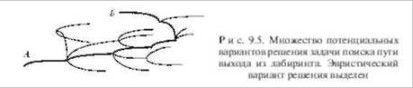
This graph, which is presented as a labyrinth, has an entrance located at point A and an exit located at point B. To find a way out of it, you need to go through many options. At the same time, both the search and the time spent on the solution can be drastically reduced by having additional information: for example, skills in compiling maps and working with a compass, or knowing where to turn at the fork in the maze.
Such problems arise when solving almost any intellectual problem, whether it is playing chess, solving a puzzle, or planning/solving creative problems. The enumeration of all available solutions in the absence of guides, fundamentally important ideas or information quickly ends with a “brute force explosion”.
Example 2
Suppose someone is busy looking for a cipher on the combination lock of a safe. If this person has absolutely no information, even about the general principles for constructing this cipher, then he is unlikely to be able to find the right solution. The number of combinations will increase like an avalanche with each turn of the drum.
Definition 3
Based on a similar analysis of a large number of other examples, one can determine concept heuristic solution as a solution that is associated with a sharp decrease in the enumeration of options for possible solutions.
Let's take a chess game as an example. The set of the most elementary heuristic recommendations includes the following:
- control of the four central cells of the field;
- ensuring the safety of the king;
- preventing the opening of their own verticals;
- figure protection and much more.
It is worth noting that all these recommendations are not exact algorithms, they are just guidelines for the actions of chess players, which can significantly reduce the number of potentially correct decisions. If we consider more subtle chess heuristics, we can come to the conclusion that they are also not exact algorithms of actions that can lead to the goal. Heuristic rules are characterized by the ambiguity of intermediate results, so the categorical accuracy of recommendations is not allowed (51:109-114). Heuristic recommendations for chess are some kind of rules: for example, the highest preference is given to a check, with the help of which the opponent's king will move away from its base, or at least simply move.
Conclusion
After analyzing such facts, we can conclude that judgments that are plausible, which increase the likelihood of approaching the correct solution, have heuristics. Such reasoning is not precise, but their strategy is based on narrowing the entire enumeration area to a certain zone and directing thinking to work with a narrow class of concepts/facts based in it. At the same time, it should be noted that heuristics are not a way to find exact solutions within this zone. If we characterize them by a sports analogy, then the business of heuristics is to “throw the puck into the zone”, but by no means carry it into the goal.
Examples of heuristic principles
>The laws of heuristics are more principles than rules, with clear boundaries of the conditions of application. Perhaps it would be more accurate to draw an analogy with the concept of attitude, which has the form of a general prescription for action, and consider heuristics as mental attitudes. Vivid examples of such rules are proverbs, aphorisms and sayings. For example, “Measure a hundred times, cut once”, “Better a titmouse in the hand than a crane in the sky”, “Fills a jug with water drop by drop” and others - they indicate a clear direction, but do not give exact instructions for action in a particular situation.
In Poya's book How decide task” (476: 99-103) is given system English proverbs, which was selected by the author as illustrations of the main stages of problem solving. For example, “Whoever understands poorly, answers poorly” - there is no analogue to this in Russian, but she very accurately formulates the classic pedagogical statement “Before you start solving a problem, understand its conditions.” Other proverbs, for example, “A wise man changes his mind, a fool never”, “Effort is the mother of luck”, “An oak falls with one blow”, “Where there is a desire, there is a way!” and similar ones contain only general recommendations on the course of action. They encourage the search for personal interest in the process / result, perseverance, thinking through the current situation from various angles.
The most interesting consideration is the rules of human behavior in society: in the family, in the team, at work. An analysis of the famous book by D. Carnegie "How to win friends and influence people" (27:84-93) clearly shows that almost all "Carnegie's rules" are heuristic recommendations. Their meaning can be formulated as a set of instructions on what rules should be used to achieve the shortest path to gaining a position in society or reaching the top of a career, a lot of money or the love of others. In order to clearly prove the heuristic and usefulness of these recommendations, it is worth bringing their final system, which called"Nine ways change people's minds without causing resentment or resentment (behavior of a manager at work):
- The conversation should begin with sincere admiration and praise.
- Do not directly tell the person about the mistakes he made.
- Before criticizing another, first point out your own mistakes.
- Instead of giving orders, ask questions.
- It is always worth giving the opportunity to save your reputation to another.
- It is necessary to praise others even for the smallest achievements, while this must be done sincerely and not skimping on praise.
- A person needs to create a good reputation that he can justify.
- It is necessary to resort to encouragement, trying to show the opponent that the mistake he made is easy to correct or that what is required of him is easily feasible.
- It is necessary to act in such a way that a person is happy to fulfill the offer.
Heuristic methods of teaching or methods of pedagogical heuristics are various tricks/methods that the teacher uses in process learning the ability to find creative non-standard solutions to both simple and non-trivial problems.
But how can one explain the fact that heuristic methods do not make it possible to use precise rules that can directly lead to the solution of the problem. Partially, this can be answered by the example of the semantic network model. For example, a creative solution to a problem can be represented as a transition from one knowledge node to another. In this case, the transition, which is carried out in a three-dimensional environment that serves as an imitation of the brain, or by means of a connection that has a low priority/rarely used, or by building a new connection. Then, within the model itself, what is an exact recommendation is equivalent to a decision. Otherwise, the recommendation can only indicate the direction of the solution, which makes it a heuristic.
If you notice a mistake in the text, please highlight it and press Ctrl+Enter
Modern society makes more and more demands on the individual. In order to be successful in modern society, a graduate of a school or university must not only have a number of subject knowledge, skills and abilities, but also be an active, creatively developed personality capable of quickly finding non-standard solutions to emerging problems.
One of the features of a foreign language in teaching is that it can simultaneously act as both a goal and a means of learning, thus being an ideal basis for the development of students' creative abilities in parallel with their acquisition of language knowledge, skills and abilities. The use of heuristic methods in a foreign language lesson can contribute not only to the formation and development of creative and communication skills of students, but also to activate the studied lexical and grammatical material. Taking into account the requirements of the modern Federal State Educational Standard of basic general education, we propose the introduction of the following methods into the educational process when teaching vocabulary at the senior stage of education.
What is heuristic learning? Innovative teaching methods. Among the innovative teaching methods, heuristic learning is distinguished, the prototype of which is the method of questions and reasoning of Socrates, or, in other words, “Socratic irony”. It is known that the ancient Greek philosopher led his students to a true judgment through dialogue. He first asked a general question, and having received an answer, he again introduced a clarifying question, and so on until a final answer was received.
Khutorskoy A.V.: Heuristic learning aims to construct the student's own meaning, goals and content of education, as well as the process of its organization, diagnosis and awareness. The student's personal experience becomes a component of his education, and the learning content is created in the process of activity.
Heuristic activity is sometimes associated with creative activity. However, the first concept is broader and has a number of differences:
1. Heuristic activity includes the creative processes themselves to create educational products.
2. One of the components of heuristic activity is the cognitive processes that are necessary to accompany creativity.
3. In heuristic activity, organizational, methodological, psychological and other processes provide creative and cognitive activity.
The main task in heuristic learning is the creative self-realization of the student. This is done in the following way. The student receives material for construction, but he is not given ready-made knowledge about it. He creates a product of activity (a hypothesis, an essay, a craft), and then, with the help of a teacher, compares it with historical analogues in this area. As a result, the student rethinks his result and his personal transformation takes place (a change in feelings, knowledge, abilities and experience).
The result of the student's activity can also be a general cultural increment, when the student is involved in cultural and historical processes. The heuristic educational situation is a key element of learning. This situation activates ignorance, its purpose is the birth of a personal idea, problem, hypothesis, scheme, text, etc. by the students. The educational result in heuristic learning is unpredictable, each student can get completely different results.
Heuristic learning is based on open tasks. Almost any element of the topic under study can be expressed in the form of an open task.
Today in our master class, I want to introduce you to some heuristic methods.
As I already said, heuristic teaching methods are those that always result in educational products created by students: an idea, a hypothesis, a text work, a picture, a craft, a plan of their classes, etc.
The first method we will be introduced to is the empathy method.
The empathy method means “feeling” a person into the state of another object, “settlement” of students in the studied objects of the surrounding world, an attempt to feel and know it from the inside.
For example, get used to the essence of a tree, a cat, a cloud and other educational subjects. At the moment of getting used to, the student asks questions to the object-self, trying to perceive, understand, see the answers on a sensual level. The thoughts, feelings, sensations that are born at the same time are the educational product of the student, which can then be expressed by him in oral, written, pictorial form.
And now I will ask you to break up with the help of color into teams of 3-4 people.
teacher: Imagine yourself that you are ‘Tornado’. How can you describe yourself, what are your feelings? Name your adjectives, verbs, your favorite season, places you occur, your weather.
(5 minutes are allotted for work) Then each team reads out their resulting stories.
Teacher: and here is an example that the student got
student:- I am Tornado. I am the most terrible of all storms. I am dangerous, violent, strong, cruel, noisy and destructive. I destroy houses, carry away cars and telephone boxes. I occur in the springs, throughout the world, but mostly in the United States, especially in the central states. I occur in the afternoon or in the early evening in a hot day. Large clouds appear in the sky. They become darker and darker. The sounds of thunder, bright flashes of lighting! I form a funnel and begin to twist. My funnel touches the ground, it picks up everything it can.
Next method: Method "Mind-Map" (Memory Map). This method is somewhat similar to the "cluster" method in critical thinking.
“Mind-Map” Method is a simple technology for recording thoughts, ideas, conversations. Recording is fast, associative. The topic is in the center. First there is a word, an idea, a thought. There is a stream of ideas, their number is unlimited, they are all fixed, we begin to write them down from the top left and finish at the bottom right.
The method is an individual product of one person or one group. Expresses individual capabilities, creates space for the manifestation of creative abilities.
Possibilities of using “Mind-Map”
- When systematizing, repeating the material;
- When working with text;
- When repeated at the beginning of the lesson;
- When introducing a topic;
- When collecting the necessary language material;
- Under control.
Task for groups:
Brain Storming Method
By brainstorming, students name everything they know and think about the topic, problem. All ideas are accepted, whether they are correct or not. The role of the teacher is that of a guide, forcing students to think while listening carefully to their considerations.
Property list method
The method consists in dividing the subject or idea into key constituent properties. The properties of an item may include its size, shape, taste, color, weight, smell, contents, packaging, and so on. Determining the key properties and decomposing an object by its properties allows you to consider the object in more detail and, working with each property separately, produce a new, more advanced product or idea. According to A. J. Starko, the property list method can be applied to any academic discipline and for any age of students.
Example: Divide into groups of three. Each group will get a picture of different kinds of vehicles. You are to discuss the main qualities of the vehicle and make a list of them. Then you'll have to think of one quality that can be changed to make the vehicle better. What will that be? What will the change bring? Present the updated kind of transport to the other groups.
Exclusion method
Students are presented with three objects, actions, numbers, concepts, etc. and it is proposed to exclude the superfluous, while explaining the choice. This method implies such a method of mental activity as a comparison, thus allowing a more detailed knowledge and understanding of the studied material or problem.
Example: Look at the given pictures (road, sky, water; plane, car, bus; run, climb, jump; etc.). You are to choose the wrong one. Explain your choice.
Method of taking into account the views of other people
The method is used when the analyzed problem involves consideration of it from different points of view. The ability to put yourself in the position of another person and look at the problem through his eyes allows you to identify aspects of the problem that have not been taken into account before.
Example: A plane that was supposed to deliver a family of three (mother, a ten-year-old son and a five-year-old daughter) that was traveling to Moscow had to make an emergency landing in Paris. The family spent for days in the city. Describe everything as if you were: the mother, the son, the daughter, the pilot of the plane, a travel agent, a taxi driver, the father of the family.
Forbidden word method
Students are encouraged to define objects or ideas, but without using common words and phrases. This method allows you to expand vocabulary, and also trains the ability to find analogies and give examples.
Example: Describe the object that you see in the picture (plane ticket) without using the following words: a plane, a ticket, transport, holidays, fly, air, a stewardess, a pilot.
Idea game method
Considering various ways of formation and development of creative abilities, A. Cropley offers the so-called method of playing with ideas. This method implies a variety of logic games, the essence of which is preparation for mental activity, a kind of exercise for the brain, during which strategies of mental activity are mastered.
Games take several minutes and can take place at the beginning of the lesson as a speech exercise, or be included in the educational process in connection with the development of new material or understanding the essence of the problem presented by the teacher. The “playing with the idea” method can be implemented through the following techniques:
– production (creation): in the process of implementing this technique, students need to put forward an idea related to the problem presented, for example, give a list of abbreviations that should be deciphered in such a way that they are relevant to the topic of the lesson;
Example: Reveal the meaning of the following abbreviations in connection with the topic of the lesson (travelling): BBC, RAF, FBI, NATO.
– analysis : represents a clear definition of the content of an object or idea and can be implemented, for example, by providing students with a list of materials and asking them to name as many ways as possible to use them, including non-standard ones;
Example: Think about all possible variants of the usage of the following objects: credit card, sun lotion, suitcase, flippers, passport.
– improvement : development of a detailed structure based on leading features, for example, students are voiced the leading principles, and are invited to describe an object, moreover, an object that does not currently exist, but is theoretically possible and expedient;
Example: Describe in detail a means of transport that can travel rather fast my road and by air, take more than five people aboard and be environmentally friendly.
– sharpening of attention : identifying key aspects of objects and ideas, for example, asking students to come up with nicknames for famous people (not personally known to them), which are a designation of the sum of those personal characteristics that make them unique;
Example: Imagine yourself a traveler who has just made a round the world voyage. You are to describe the countries you have visited, but you have little time, so describe each country using one or two words.
– association I: identifying links between elements, for example, students are invited to create as many expressions as possible by connecting all or several words of this list, and the resulting phrase must have a certain meaning, that is, to name a certain object or process in reality;
Example: You will be given a list of words. Your task is to make as many word combinations as possible. Mind that every word combination should mean a certain object. You are free to use prepositions or change the form of the words. (ticket, boat, holiday, relax, sun, sea, plane, helicopter, air, suitcase, package, swimming costume, bathe, go, travel, work, trip, enjoy, bed)
– construction : combining ideas or objects to create a specific new product, can be implemented, for example, by providing students with several arbitrary starting points and asking them to come up with an object or apparatus, moreover, as carefully worked out as possible, which would combine these elements;
Example: Imagine and describe a means of traveling that can be used by those who get airsick easily, those you are afraid of water and enjoy speed and comfort.
– transformation : expression of ideas through other forms or means, for example, to invite students to draw the essence of the interjection “yum-yum”;
Example: Listen to the text about a voyage. While listening, draw pictures, describing emotions of the main character during the voyage. Retell the text with the help of your pictures.
The above-mentioned techniques within the framework of the “playing with the idea” method, according to A. Cropley, are applicable with the appropriate transformation to any academic subject, both individually and in combination.
The method of "playing with ideas" can be applied in groups of any age, can be adapted to any educational subject or used outside of educational activities in order to develop the creative abilities of students.
Imaging method
This method is designed to assist students in understanding the essence of the problem or educational issue. Students are encouraged to close their eyes, relax and recall some moment from their life experience. At the same time, the teacher asks questions that help guide the student to solve the problem, taking into account his personal experience and reflection. Then the students are asked to consider the problem, taking into account the reflections that take place during reflection. The visualization method helps students apply their knowledge and experience to solve a pressing problem.
Example: close your eyes. Imagine yourselves going to the holiday of your dream. You have been working hard all the year round and now it is the time for you to relax. You are in your room packing. You have a large suitcase and are putting in it everything you will need. What have you taken with you? Now you are on your way to the destination. What means of transport have you chosen, why? Is the travel comfortable? What are the people around you doing? What do you see through the window? Now you have come to the point of your destination. What is it like? Are you happy? What are you going to do first? Now open your eyes and tell the others about your imaginary trip and the feelings that you had while traveling.
In my opinion, the use of heuristic teaching methods is one of the best means of forming and developing the creative abilities of students, and can be integrated into the educational process at any stage along with the use of traditional methods and forms of teaching a foreign language.
Used Books:(Internet materials)
1. Bakhramova O.N."Relevance of heuristic methods of teaching foreign languages".
2. Doroshko N.V."A heuristic method of teaching a foreign language, from play to creativity: guidelines".
3. Skvortsova S.V."Heuristic methods as a means of developing the creative abilities of students in teaching foreign languages".
Cognitive learning methods, or methods of educational knowledge, are divided into methods of science, methods of educational subjects and meta-subject. Scientific methods are research methods in physics, mathematics, geography and other sciences. These include methods of comparison, analogy, synthesis, classification, etc.
The methods of educational subjects, on the one hand, are taken from the sciences, on the other hand, they relate to the direct mastery of specific
educational areas and subjects. These are methods for studying fundamental educational objects, methods for comparing educational products of students with cultural and historical analogues, traditional methods for studying the main issues and topics of training courses.
A special kind of cognitive teaching methods are meta-subject ones, which are metamethods, corresponding to the metacontent of education. For example, a meta-method is a method of cognitive vision of the meaning of an object, meta-subject content is such objects of knowledge as matter, plant, sound.
Creative teaching methods provide students with the opportunity to create their own educational products. The traditionally understood methods of the intuitive type refer to creative methods: brainstorming, the empathy method, the pedagogical methods of the student in the role of a teacher, etc. Such methods are based on non-logical actions of students that are intuitive in nature.
Another type of creative teaching methods is based on the implementation of algorithmic prescriptions and instructions: methods of synectics, morphological box. Their goal is to create a logical framework for the creation of educational products by students.
The next type of creative methods are heuristics, i.e. techniques that allow students to solve problems by "pointing" to their possible solutions and by reducing the options for enumeration of such solutions.
Organizational methodslearning are divided into methods of students, teachers and education managers - the main subjects of education. Methods of students are methods of educational goal-setting, planning, control, reflection, etc. This group of methods is unconventional for schools, students usually hardly participate in the construction of their education. It is no less important to teach children the methods of organizing and building their own educational trajectory than the methods of the sciences they study.
Education management methods- these are pedagogical and administrative methods of organizing educational processes at the appropriate level. They are in many ways identical to the organizational methods of students, since the same principles apply to a teacher, a particular school or the entire education system as to teaching individual students. This group of methods is used in the creation and development of educational processes on the scale of teaching a single course, a group of courses, or the entire school.
COGNITIVE METHODS
A feature of cognitive methods (methods of educational knowledge) is that their application leads to the creation of educational products, i.e. creative result. Therefore, the methods of cognition are also creative. However, the primary purpose of using these methods is the knowledge of the object, so their main specificity is associated with cognitive rather than creative processes.
The empathy method means “feeling” a person into the state of another object. Based on the ancient idea of correspondence between macro- and microcosm, human knowledge of the surrounding world is the communication of like with like. Man's mission here is to move into his home, into the Universe. The method of empathy is quite applicable for the "settlement" of students in the studied objects of the surrounding world. Through sensory-figurative and mental representations, the student tries to "move" into the object being studied, to feel and know it from the inside.
The condition for the successful application of the empathy method is a certain state of the students, the mood created by the teacher.
At first, it may be like a game to which children react, usually with some amusement. Then, when the educational results are received and realized, the students will stop taking this method lightly and accept it as a truly educational method.
To get used to the essence of a tree, stone, cat, cloud, candle and other educational objects, the use of verbal instructions such as: “Imagine that you are the plant that stands in front of you, your head is a flower, your body is a stem, your arms- leaves, legs - roots ... " At the moments of the best “getting used to it”, the student asks questions to the object-himself, tries to perceive, understand, see the answers on a sensual level. The thoughts, feelings, sensations that are born at the same time are the educational product of the student, which can then be expressed by him in oral, written, sign, motor, musical or pictorial form. Observation of the object in this case turns into self-observation of the student, who manages to identify himself with the object.
Students usually note that such exercises develop the ability to think and understand phenomena from different points of view, they teach to include not only the mind, but also feelings in cognition.
This method turns out to be extraordinarily effective, since it includes the usually unused abilities of children. Children of primary school age are characterized by the ability to experience the observed, to sensually cognize the surrounding objects, using the methods of their “humanization”.
The method of semantic vision. This is a continuation and deepening of the previous method. The simultaneous concentration of students on the educational object of their vision and "inquisitively tuned" mind allows them to understand (see) the root cause of the object, the idea contained in it, the first meaning, i.e. the internal essence of the object. Also, as in the method of empathy, it requires the creation of a certain mood in the student, consisting of active sensory-mental cognitive activity. The teacher can offer students the following questions for semantic "questioning": What is the reason for this object, its origin? How is it arranged, what is going on inside it? Why is he like this and not something else? Exercises for the purposeful application of this method lead to the development of such cognitive qualities in students as intuition, insight, insight.
Figurative vision method- emotional-figurative study of the object. It is proposed, for example, looking at a number, figure, word, sign or real object, draw the images seen in them, describe what they look like. An educational product as a result of the observation of students is expressed in a verbal or graphic figurative form, i.e. students speak, write down or draw the results of their research.
The method of symbolic vision. A symbol, as a deep image of reality, containing its meaning, can act as a means of observing and cognizing this reality. The method of symbolic vision consists in finding or building connections between the object and its symbol by the student. After clarifying the nature of the relationship between the symbol and its object (for example, light is a symbol of goodness, a spiral is a symbol of infinity, a dove is a symbol of peace, a pancake is a symbol of Shrovetide), the teacher invites students to observe an object in order to see and depict its symbol in a graphic, symbolic , verbal or otherwise. An important place is occupied by the explanation and interpretation of the "symbols" created by the children.
Heuristic question method developed by the ancient Roman teacher and orator Quintilian. To find information about any event or object, the following seven key questions are asked: Who? What? What for? Where? How? How? When? Pair combinations of questions generate a new question, for example: How-When? The answers to these questions and their various combinations generate unusual ideas and solutions regarding the object under study.
Comparison method is used to compare versions of different students, their versions with cultural and historical analogues, which were formulated by great scientists, philosophers, theologians, when comparing various analogues with each other. To teach this method, students are asked questions: What does it mean to compare? Is it always possible to compare everything? Point out what, in your opinion, cannot be compared, and try to compare the incomparable nevertheless.
Heuristic observation method. Observation as a purposeful personal perception of various objects by a student is a preparatory stage in the formation of his theoretical knowledge. Observation is the source of the student's knowledge, a way of obtaining them from the reality of being, i.e. it can be attributed to heuristic teaching methods.
Observing students receive their own result, including: a) the informational result of observation; b) the method of observation used; c) a complex of personal
ny actions and sensations that accompanied the observation. The degree of creativity of the student in the course of his observation is determined by the novelty of the results obtained in comparison with those already available to him before.
Simultaneously with receiving the information given by the teacher, many students during the observation see other features of the observed object, i.e. acquire new information and construct new knowledge. This process is either spontaneous, if the teacher does not organize it, or purposeful, if the teacher uses a special methodology for teaching observation. The purpose of this method is to teach children to extract and construct knowledge through observation.
Fact method. Conscious possession by students of the physical sense organs requires consistent development in further cognitive activity. First of all, this refers to such a stage of cognition as the search for facts, their difference from non-facts. Experience shows that it is not easy for students to distinguish between what they see, hear, feel, and what they think. The need for natural perception of educational objects with the help of physical senses requires the use of this teaching method, revision and change of the usual content of education.
Here is a fragment of the lesson, which discusses the facts found by students about the burning of a match, reveals knowledge about the methodology of cognition:
Alexei:“... At first, the gray smoke went, then it disappeared, I saw a flame, it was of different colors - blue, orange, green, water appeared on the match itself near the flame ...”
Stella:"The smoke has dissolved - this is not a fact, maybe it does not dissolve."
Paul:“Water on a match? It's not a fact!" (Specially checked. It turned out that liquid actually appears near the flame.)
Galya:“Lesha was carried away by one and did not see what was happening at the same time. You can compare facts that happen at the same time. It will be a new fact."
Research method. The object of study is selected - natural, cultural, scientific, verbal, symbolic or other: a leaf of a tree, a stone, a drop of water, an element of clothing, a poem, a saying, signs, a letter, a number, a sound, an equation, a geometric figure, a rite. Students are invited to independently explore a given object according to the following plan: research objectives - work plan - facts about the object - experiments, drawings of experiments, new facts - questions and problems that have arisen - versions of answers, hypotheses - reflexive judgments, conscious methods of activity and results - conclusions. Such algorithmization of students' activities does not detract from their creativity. On the contrary, by completing all the steps listed in sequence, almost any student will inevitably receive their own educational result. The teacher helps the children to increase the volume and quality of such a result. This is achieved by systematic repetition of the algorithmic stages of the study.
Concept construction method. The formation of the studied concepts in students begins with the actualization of their existing ideas. For example, younger students already know the terms "number", "word", "sky", "winter", "movement"; older students - "algorithm", "value", "molecule", etc. By comparing and discussing children's ideas about the concept, the teacher helps to build them up to some cultural forms (not necessarily to those that are in textbooks!). The result of such work is a collective creative product - a jointly formulated definition of a concept, which is written on the board. At the same time, the teacher invites the children to get acquainted with other formulations of the concept, which are given, for example, by the authors of various textbooks or other books. Various formulations remain in the students' notebooks as a condition for their personal self-determination in relation to the concept being studied.
Rule construction method. The rules studied in general education courses can be created, “discovered” by students. For example, from the text proposed by the teacher, students identify the spellings that underlie the rules, and then create their own texts based on these rules. The study is conducted according to the algorithm specified by the teacher, which depends on the type of text and the task. For example, to study the literature of the epic in the lessons of the literature, the algorithm of activity has the following form: a) formulate the features of the style of the epic; b) detect the spelling, the rule underlying the text; c) formulate the linguistic features of the epic.
The method of hypotheses. Students are offered a task - to construct versions of answers to the question or problem posed by the teacher. The initial task is to choose the basis for constructing versions. Students offer initial positions or points of view on the problem, learn a diverse scientific, diverse approach to constructing hypotheses. Then they learn to formulate their answers to the question most fully and clearly, relying on logic and intuition.
The method of hypotheses develops when solving prognostic problems such as "what will happen if ...". The method of traveling to the future is effective in any educational field as a way to develop the skills of foresight, forecasting, hypotheticality.
Prediction method differs from the hypothesis method in that it is applied to a real or planned process. For example, students are invited to investigate the dynamics of changes in a pea seed placed in a humid environment. Children make observations, make sketches. The teacher offers the students a task: draw a sprout as it will become in 3 days, in a week, etc. Students, relying on previous observations, discovered patterns and their own predictive abilities, perform a drawing. After a given time, the forecast is compared with reality, the results are discussed, and conclusions are drawn.
error method. This method involves changing the established negative attitude towards mistakes, replacing it with the constructive use of mistakes (and pseudo-errors) to deepen educational processes. Error is considered as a source of contradictions, phenomena, exceptions to the rules, new knowledge that is born in opposition to the generally accepted ones. Attention to the error can be not only for the purpose of correcting it, but also to find out its causes, ways to get it. Finding the relationship between error and "correctness" stimulates the heuristic activity of students, leads them to an understanding of the relativity and variability of any knowledge.
Theory Construction Method. Students are invited to perform a theoretical generalization of their work in the following ways: 1) the facts discovered by the students are classified according to the bases given by the teacher, for example: facts about the structure of an object, facts about its functions, facts about processes, facts about relationships; 2) types of positions of observers are clarified, for example, chronological position (successive fixation and description of events), mathematical (quantitative characteristics of the object, its shape and proportions are studied), figurative (expressive verbal characteristics of the object, its symbolic features are found); 3) questions and problems are formulated relating to the most remarkable facts, for example: Does the color of wax affect the color of a candle flame? Where does the burnt part of the wick go? Why can't you take the flame in your hands?
Further classes ensure the development of the educational process in the following sequence of theoretical generalizations.
ny: facts - questions about them - hypotheses of answers - construction of a theoretical model - consequences of the model - evidence of the model (hypotheses) - application of the model - comparison of the model with cultural counterparts. Methods for constructing a theoretical model by students are established by the teacher depending on the educational area or topic being studied.
CREATIVE METHODS
Creative teaching methods are focused on the creation of a personal educational product by students. In this case, cognition is possible, but it occurs "in the course" of the actual creative activity. The main result is a new product.
Invention Method- this is a way to create a product previously unknown to students as a result of their certain mental actions. The method is implemented using the following techniques: a) replacing the qualities of one object with the qualities of another in order to create a new object; b) finding the properties of an object in a different environment; c) a change in the element of the object under study and a description of the properties of the new, changed object.
The "if only" method. Students are invited to write a description or draw a picture of what will happen if something changes in the world, for example: the force of gravity will increase 10 times; endings in words or the words themselves will disappear; all volumetric geometric shapes will turn into flat ones; predators will become herbivores; all people will move to the moon, etc. The implementation of such tasks by students not only develops their ability to imagine, but also allows them to better understand the structure of the real world, the relationship of everything with everything in it, the fundamental foundations of various sciences.
Figurative painting method recreates such a state of the student, when the perception and understanding of the object being studied seem to merge, his holistic, undivided vision occurs. As a result, the student has a figurative picture of a flower, a tree, a cloud, the Earth or the entire Cosmos. Since it is very important for a person to be able to create and convey a holistic image of a cognizable object, students are invited to depict, for example, their picture of nature or the whole world, i.e. to express with the help of drawings, symbols, key terms the fundamental foundations of nature, the connections between them. During such work, each student not only thinks on a different scale, correlates his knowledge from different fields of science, but also feels, feels the meaning
depicted reality. By offering such a task 2-3 times a year, it is possible to assess changes in students' worldviews and make the necessary adjustments to the learning process.
hyperbolization method. The object of knowledge, its individual parts or qualities, increases or decreases: the longest word, the smallest number is invented; aliens are depicted with large heads or small legs; the sweetest tea or a very salty cucumber is prepared. The starting effect of such imaginations can be given by the Guinness World Records, which are on the verge of going out of reality into fantasy.
agglutination method. Students are invited to combine qualities, properties, parts of objects that are not connected in reality and depict, for example, hot snow, the top of an abyss, the volume of emptiness, sweet salt, black light, the power of weakness, a running tree, a flying bear, a meowing dog.
"Brainstorm"(A.F. Osborne). The main task of the method is to collect as many ideas as possible as a result of freeing the discussion participants from the inertia of thinking and stereotypes. The assault begins with a warm-up - a quick search for answers to questions of a training nature. Then the task is clarified once again, the rules of discussion are reminded, and - start.
Everyone can express their ideas, supplement and clarify. An expert is attached to the groups, whose task is to record the ideas put forward on paper. "Storm" lasts 10-15 minutes. For the "assault" questions are proposed that require an unconventional solution. For example: How to determine the length of a copper wire wound on a coil without unwinding it? How to determine without a compass whether an unfamiliar planet has a magnetic field or not? How, without resorting to additional lighting, can you see objects under water?
The work is carried out in the following groups: generating ideas, analyzing the problem situation and evaluating ideas, generating counter-ideas. The generation of ideas takes place in groups according to certain rules. At the stage of generating ideas, any criticism is prohibited. Replicas, jokes, relaxed atmosphere are strongly encouraged. Then the ideas received in groups are systematized, united according to general principles and approaches. Further, various obstacles to the implementation of the selected ideas are considered. The criticisms made are evaluated. Only those ideas are finally selected that have not been rejected by critical remarks and counter-ideas.
Brainstorming process consists of the following steps.
1. Formulation of the educational problem, substantiation of the problem to find its solution. Definition of conditions and rules of collective work. Formation of several working groups of 3-5 people and an expert group that will evaluate and select the best ideas.
2. Warm up. Quick search for answers to questions and tasks of a training nature. The purpose of this stage is to help students get rid of awkwardness, constraint, stiffness.
3. "Storm" of the problem. Once again, the task is specified, the rules of discussion are recalled. The generation of ideas begins at the signal of the teacher simultaneously in all groups. Everyone expresses their ideas aloud. It is forbidden to criticize the proposed ideas, you can only supplement and combine them. An expert is attached to each group, whose task is to record the ideas put forward on paper. "Storm" lasts 10-15 minutes.
4. Evaluation and selection of the best ideas by a group of experts.
5. Reporting the results of brainstorming. Discussion of the results of the work of groups, evaluation of the best ideas, their public defense.
Synectics method(J. Gordon) is based on the method of brainstorming, various types of analogies (verbal, figurative, personal), inversion, associations, etc. First, the general signs of the problem are discussed, the first solutions are put forward and eliminated, analogies are generated and developed, the use of analogies to understand the problem , alternatives are selected, new analogies are sought, and the problem is returned to. In synectics, analogies are widely used - direct, subjective, symbolic, fantastic (Granovskaya, Krizhanskaya, 1994, pp. 129-130).
Morphological box method or the method of multidimensional matrices (F. Zwicky). Finding new, unexpected and original ideas by making various combinations of known and unknown elements. The analysis of features and relationships obtained from various combinations of elements (devices, processes, ideas) is used both to identify problems and to search for new ideas.
Inversion method or call method. When stereotyped techniques prove fruitless, a fundamentally opposite alternative solution is used. For example, they try to increase the strength of the product by increasing its mass, but the opposite solution turns out to be effective - the manufacture of a hollow product. Or, the object is examined from the outside, and the solution of the problem occurs when considering it from the inside. K.E. Tsiolkovsky "invented a cannon, but a cannon flying, with thin walls and letting out gases instead of nuclei ...".
§ 4. Organizational methods of justice
Methods of the organizational activity type are represented by a sufficient number of individual methods that are combined into groups.
Methods of student goal setting: students' choice of goals from the set proposed by the teacher; classification of goals compiled by children with subsequent detailing; discussion of student goals for realism and achievability; designing goals by students using predetermined algorithms; compiling by students of their own taxonomy of educational goals and objectives; formulating goals based on the results of reflection; the ratio of individual and collective goals, the goals of the student, teacher, school; development of value norms and provisions at school.
Methods of student planning. Schoolchildren are invited to plan their educational activities for a certain period - a lesson, day, week, or on a topic, section, creative work. The plan can be oral or written, simple or complex, the main thing is that it indicates the main stages and activities of the student to achieve his goal. In the course of work, the plan may be changed, supplemented or replaced; the student fixes the changes, finds out their causes, and at the end of the work carries out a planning reflection.
Methods for creating educational programs for students. The creation of individual educational programs requires students to master a set of methods: semantic vision of the subject of their studies; setting the main goals and directions of activity; selection of studied issues and topics, the method of self-determination in their diversity; planning method; the method of determining the conditions for achieving their goals; method of adequate self-assessment and reflection.
Rulemaking methods. The development by students of the norms of individual and collective activity is a heuristic process that requires the use of methodological methods: reflection of activity, determining its elements, establishing subjects of activity and their functional rights, setting organizational and thematic frameworks, formulating rules and laws.
Examples of tasks that develop methodological, pedagogical, reflexive abilities in the process of rule-making: Make instructions: “How to pronounce a word”, “How to study a word”, “How to solve a problem”, “How to observe a phenomenon”, “How to listen to music”, etc.
Methods of self-organization of learning: work with a textbook, primary sources, devices, real objects; solving problems, performing exercises; making models, crafts; creative research, etc. Methods of self-organization of students in the implementation of individual educational programs are also becoming significant: methods for developing programs, their coordination with other programs (teachers, students), correction of programs, methods for evaluating results, etc.
Mutual learning methods. Students in pairs, groups or in collective lessons with the whole class perform the functions of a teacher, applying a set of pedagogical methods available to them.
The review method. The ability to take a critical look at the educational product of a friend, his oral answer, the material of the textbook, the watched video film, analyze their content, highlight the main points - the necessary conditions for self-
student definitions. The introduction of the review method into training is preceded by preparatory work. The first reviews are compiled using special reference schemes. Evaluations and judgments of students are encouraged, a positive attitude towards reviews is fixed.
Students' reviews are evaluated on a par with other products of their creative activity. The analysis of student reviews allows you to establish feedback with students, diagnose their knowledge, and correct further learning.
Control methods. Heuristic learning changes the criteria for evaluating educational activities. In traditional education, the student's educational product is evaluated by the degree of its approximation to a given model, i.e. the more accurately and fully the student reproduces the given content, the higher the assessment of his educational activity. In heuristic learning, the student's educational product is evaluated by the degree of difference from the given one, i.e. the more scientifically and culturally significant difference from a known product a student manages to achieve, the higher the assessment of the productivity of his education.
Reflection methods. The educational result of learning is only that which is realized by the student.
The organization of students' awareness of their own activities has two main types: 1) current reflection carried out in the course of the educational process; 2) final reflection, completing a logically or thematically closed period of activity.
Current reflection involves the organization of mental activity of students according to the type of shuttle: after a cycle of objective activity (mathematical, historical, linguistic, etc.) is completed, the following occurs: a) stop of objective activity; b) activation of reflexive activity, i.e. return of children's attention to the main elements of the implemented objective activity: its directions, types, stages, problems, contradictions, results, methods of activity used.
Final reflection differs from the current one in the increased volume of the period under review, as well as in a greater degree of assignment and certainty on the part of the teacher. The forms, methods and content of the final reflection are included in the teacher's educational program. At the end of the lesson, day, week, quarter, academic year, students are offered a special lesson in which they reflect on their activities, answering the questions: What is my biggest work for the school year? How have I changed in a year? What is my biggest success? Why and how did I achieve it? What is my biggest difficulty? How did I overcome it or will I overcome it? What didn’t work for me before, but now it works? What are the changes in my knowledge? What did I understand about my ignorance? What have I learned in math, language, etc.? What have I learned to do? What new types and methods of activity have I applied and learned? What are the main stages of my education this academic year, what are their specifics?
Self-Assessment Methods. The student's self-assessment follows from the final reflection and completes the educational cycle. Self-assessment is of a qualitative and quantitative nature: qualitative parameters are formulated on the basis of the student's educational program or are set by the teacher; quantitative - reflect the completeness of the student's achievement of goals. Qualitative and quantitative self-assessment of the student's activity is his educational product, which is compared with cultural and historical analogues in the form of assessments of the teacher, classmates, independent experts.
In heuristic learning, the main factor in the choice of teaching methods is the task of organizing the productive activity of students. .
Linguistic Encyclopedic Dictionary / Ch. ed. V.N. Yartseva, - M.: Sov. Encyclopedia, 1990. - 685 p. P.298.
Khoruzhenko K.M. Culturology. Encyclopedic Dictionary. - Rostov-on-Don: Phoenix Publishing House, 1997 - 640 p. P.302.
Philosophical Dictionary. / Ed. I.T. Frolova. – M.: Politizdat, 1986. – 560 p. S. 278.
Russian Pedagogical Encyclopedia: In 2 vols. / Ch. ed. V.V. Davydov, - M.: Great Russian Encyclopedia, 1993. - 608 p. T. 1 - A - M. S.298.S. 566.
Kapterev P.F. pedagogical process. - St. Petersburg, 1905.
Golant E.Ya. Teaching methods in the Soviet school. - M., 1957.
Lordkipanidze D.O. Principles of organization and teaching methods. - M., 1957.
Danilov M.A., Esipov B.P. Didactics, - M., 1957
Basics of didactics. / Ed. B.P. Esipov. - M., 1967.
Babansky Yu.K. Methods of teaching in a modern comprehensive school. - M., 1985.
Lerner I.Ya. Didactic foundations of teaching methods. - M., 1981.
Skatkin M.N. Process improvement. - M., 1971.
Didactics of secondary school. / Ed. M.N. Skatkin. – M.: Enlightenment, 1982. 319 p. pp. 193 - 207.
1. Pedagogy / Under the editorship of P.N. Gruzdeva and others - M., 1940.
2. Pedagogy / Ed. I.T. Ogorodnikova, P.N. Shimbareva. - M., 1954.
3. Pedagogy / Ed. I.A. Kairova, N.K. Goncharova, B.P. Esipova, L.V. Zankov. –M., 1956.
4. Lordkipanidze D.O. Principles, organization and methods of teaching. –M., 1957.
5. Danilov M.A., Esipov B.P. Didactics. –M., 1957.
6. Golant E.Ya. Teaching methods in the Soviet school. –M., 1957.
7. Lemberg R.G. School teaching methods. – Alma-Ata, 1958.
8. Essays on Pedagogy / Ed. A.G. Kovaleva and others -L., 1963.
9. Pedagogy: Course of lectures / Ed. G.I. Schukina and others - M., 1966.
10. Fundamentals of didactics / Ed. B.P. Esipov. –M., 1967.
11. Ogorodnikov I.T. Pedagogy. –M., 1969.
12. Ilyina T.A. Pedagogy. –M., 1969.
Lerner I.Ya. Didactic foundations of teaching methods. - M., 1981. S. 17-18.
Didactics of secondary school. / Ed. M.N. Skatkin. – M.: Enlightenment, 1982. 319 p. S. 186.
Sohor A.M. Explanation in the learning process: elements of a didactic concept. - M., 1988.
Methods of explanatory and literary reading. - L., 1978.
We consider a judgment as a statement expressing the attitude of the speaker to the content of the expressed thought, formed by predicative words (expressing properties and relations) to the object of the judgment (a separate object or a set of them). Judgments can be simple or complex. Simple judgments can be attributive, expressing the belonging of properties to a separate object, or relational judgments, reflecting the connection, the relationship of several objects. Compound propositions consist of several simple ones, interconnected by the type of conjunctive (through the logical union "and"), disjunctive (through the logical union "or") or implicative (through the logical union "if ... then") links. The formation of judgments is based on generalization. The derivation of one judgment from others is called inference.
Studies have shown that the assimilation of the content of the lecture by the listeners according to the plan previously reported by the teacher increases the memorization of the material by 10 - 12%.
For lectures on cultural disciplines, depending on the complexity and difficulty of the content, the material can be given at a speed of 60 - 80 words per minute.
The massive use of technical means leads to increased fatigue of listeners.
In this case, we can talk about working at the "automated workplace" of the student using training computer programs, information retrieval systems, etc.
For this, the methods of compiling synchronistic tables, supporting logical schemes of the text, cultural dictionaries can be used.
Chemist I.A. How to teach world artistic culture: Book. For the teacher. - 2nd ed. – M.: Enlightenment, 1994. – 160 p. pp. 136-137.
Chemist I.A. How to teach world artistic culture: Book. For the teacher. - 2nd ed. – M.: Enlightenment, 1994. – 160 p. P.45.
Bespalko V.P. Programmed learning. didactic foundations. –M., 1970.
Description of the presentation on individual slides:
1 slide
Description of the slide:
2 slide

Description of the slide:
EUREKA "Eureka!" (εὕρηκα or ηὕρηκα, lit. "found!") - the legendary exclamation of Archimedes on the occasion of his discovery of the hydrostatic law, which has become commonly used to express joy in the event of solving a difficult problem.
3 slide

Description of the slide:
Heuristic learning Modern pedagogy is becoming more flexible and allows parents and teachers to use a huge variety of teaching methods. You can choose any - as long as it is effective and does not harm the child. One of the popular innovative teaching methods is heuristic learning. Translated from the Greek heurisko - "I open", "I seek", "I find". It is about finding knowledge, answers to questions. The origins of heuristic learning should be sought in ancient Greece, in the method of the ancient philosopher Socrates. He called the teaching method he used maieutics, which literally translates from Greek as midwifery. Socrates asked his students questions, encouraged them to reason; thus knowledge was born in conversation.
4 slide

Description of the slide:
Heuristic learning Heuristic learning is learning that aims at constructing the student's own meaning, goals and content of education, as well as the process of its organization, diagnosis and awareness (A.V. Khutorskaya).
5 slide

Description of the slide:
Heuristic learning Heuristic learning combines creative and cognitive activities. The teacher does not give ready-made knowledge to the student; he provides him with an object, the knowledge of which the student must master. The object can be a historical event, a natural phenomenon, a literary work, a material for construction, etc. On its basis, the child creates a product of activity - a hypothesis, a text, a scheme, a product. The result of a child's creative activity can be absolutely unpredictable, it depends on the personality of the student. Only after that the student, with the help of the teacher, compares the result with known achievements in this area (cultural and historical analogues), rethinks it.
6 slide

Description of the slide:
Heuristic learning Despite the considerable age of the method, the concept of heuristic learning in pedagogy has been used relatively recently. Hence the lack of a single interpretation: heuristic learning can mean a form of learning (for example, a heuristic conversation), a teaching method (say, brainstorming), or a technology for the creative development of students. Heuristic learning is often confused with problem learning. But there are differences between these methods. In problem-based learning, there is a specific solution, or at least the direction of the solution. And an open task in heuristic learning does not have a correct solution, and the result is never known in advance to either the student or the teacher.
7 slide

Description of the slide:
Heuristic training The ultimate goal of heuristic training is not the acquisition of specific knowledge, but the student's creative self-realization. Accordingly, it is not the child's assimilation of certain knowledge on a particular subject that is assessed, but his creative achievements in this area.
8 slide

Description of the slide:
Heuristic learning Heuristic learning is based on certain principles. Among them: personal goal-setting of the student; choice of an individual educational trajectory; meta-subject bases the content of education; learning productivity; the primacy of the student's educational products; situational learning; educational reflection.